AI Powered LMS in 2026: What to Look For and When to Build Custom

Quick answer
Building a custom AI-powered LMS means designing a learning platform around your needs with AI features like adaptive paths, tutoring, automated grading and analytics. In 2026 organizations choose custom when off-the-shelf tools can't match their pedagogy, branding or integrations.
The AI Powered LMS Market Has a Labeling Problem
A 2025 Fosway Group Digital Learning Realities report found that 68% of L&D professionals cited AI features as a top LMS selection criterion. In the same report, only 24% said their current platform's AI capabilities met expectations after deployment.
That gap exists because the LMS market has a labeling problem. Nearly every platform in 2026 claims AI. Most mean one of three things: a recommendation engine that surfaces content based on tag matching, a chatbot wrapper sitting on top of their search, or a reporting dashboard that auto-generates a PDF summary. None of those require machine learning at any meaningful depth.
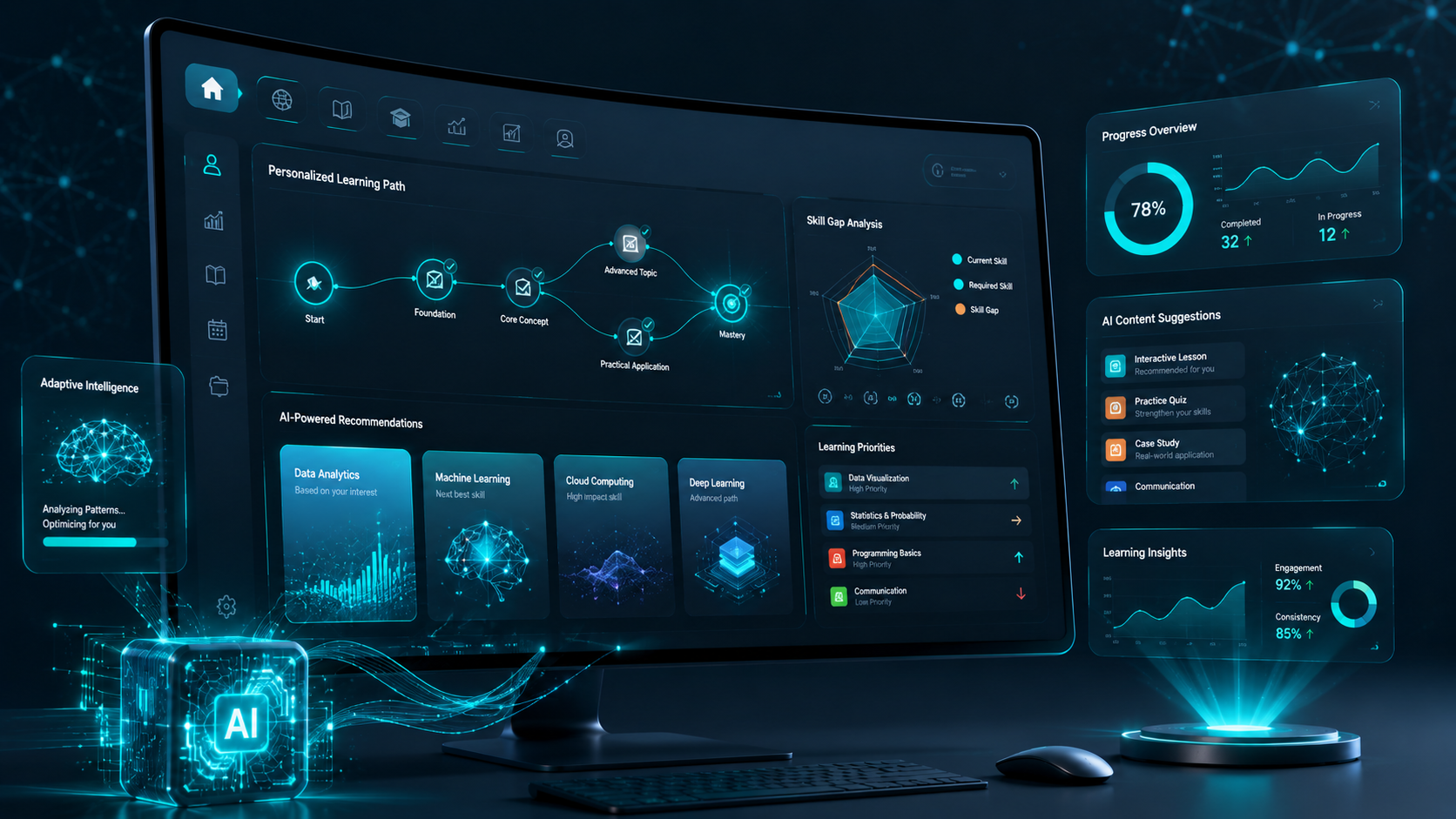
Genuine AI in an AI powered LMS means the platform adapts to individual learner behavior over time, generates or selects content without manual curation, identifies skill gaps from performance data, and improves its own accuracy with each interaction. That is a different product from one that adds "AI-powered" to its homepage.
This guide cuts through the positioning. If you are an IT director, L&D manager, or EdTech product head deciding between the major AI powered LMS platforms or evaluating a custom build, here is what actually separates the real from the relabeled.
- Most AI powered LMS platforms use rule-based automation, not machine learning: ask vendors for specifics on model training and feedback loops before signing.
- The 8 features that actually differentiate AI LMS platforms in 2026 are driven by data quality, not compute power: a platform with real-time skill inference needs clean competency data to work.
- Docebo leads for enterprise content ecosystems, 360Learning leads for collaborative SMB teams, and Cornerstone OnDemand works best when you are already inside its HR suite.
- Universities and regulated industries hit SaaS walls on SIS integration, LTI compliance, and audit-grade reporting faster than commercial teams do.
- The right threshold for a custom AI LMS build is above 25,000 active learners with three or more workflow integrations that no SaaS platform supports out of the box.
Why Most AI Powered LMS Demos Look Better Than the Product
LMS sales demos are optimized for controlled conditions. The AI features shown are real, but they require something vendors do not mention in the demo: clean, structured, complete learner data that most organizations do not have on day one.
Skill gap analysis driven by AI works by comparing observed learner performance against a competency framework. If your organization's competency model is incomplete, outdated, or nonexistent, the AI gap analysis produces generic suggestions with no actionable depth. The platform is not broken. Your input data is.
"The platform is not broken. Your input data is."TRT finding across AI powered LMS implementations, 2024-2025
The same problem applies to personalized learning paths. Adaptive path generation uses historical engagement signals to predict what a learner should do next. New implementations have no history. Until a system accumulates six to twelve months of real learner behavior, its recommendations are educated guesses based on peer cohort data at best.
Three patterns flag a vendor's AI as surface-level rather than substantive. Tag-based recommendation is the most common disguise: if the system suggests content because it shares a tag with content the learner completed, that is keyword sorting, not learning AI. Static pass/fail thresholds are the second signal: if "adaptive" paths only branch when a quiz score drops below a set percentage rather than tracking continuous performance signals, the system is rule-based.
The hardest to detect is the black-box recommendation: if the platform cannot explain why a specific course was suggested to a specific learner, there is no model underneath, just a sort algorithm dressed as AI.
AI LMS Features Buyers Should Demand in 2026
Eight features separate the platforms doing genuine AI work from those using the label for positioning. Before any vendor conversation, ask for a live demo of each. If they cannot demonstrate it against real data in under ten minutes, treat it as unavailable.
- Continuous skill inference: The platform reads learner performance signals beyond quiz scores, including time-on-task, content navigation patterns, and assessment attempts, and updates the learner's inferred skill profile in real time without requiring manual competency reassignment.
- Adaptive learning path generation: Paths branch based on granular performance signals, not binary pass/fail gates. The system adjusts sequence, pacing, and content depth at the individual level, not the cohort level.
- AI-assisted content creation: L&D teams can generate draft course outlines, quiz questions, and scenario-based exercises directly from source documents or learning objectives. This cuts authoring time, not just consumption time.
- Natural language search and discovery: Learners can describe what they need in plain language and get relevant content, not just tag matches. Semantic search backed by a vector index or large language model is the standard in 2026.
- Anomaly and at-risk learner detection: The system flags learners who are falling behind not just through score thresholds but through engagement pattern changes: reduced login frequency, partial completion spikes, repetitive quiz attempts on the same item.
- Automated content curation from external sources: The platform ingests external content libraries, LinkedIn Learning, Coursera for Business, internal documents, and surfaces the right piece to the right learner without manual tagging by an L&D admin.
- Measurable learning-to-performance correlation: The platform connects learning activity data to downstream business outcomes via API or native integration with your HRIS or performance management system. Without this, ROI from L&D remains anecdotal.
- Explainable AI recommendations: Every AI-generated suggestion includes a visible rationale the learner and manager can read. "Recommended because your team members in similar roles completed this before their Q2 certification" is meaningful. "Recommended for you" is not.
TRT's team has scoped and deployed custom AI learning platforms for EdTech clients across the US and GCC. Talk to TRT's EdTech engineering team →
Best AI Powered LMS Platforms in 2026: Docebo vs Cornerstone vs 360Learning vs Custom Build
The three SaaS platforms most commonly shortlisted for enterprise and mid-market AI LMS deployments in 2026 are Docebo, Cornerstone OnDemand, and 360Learning. Each targets a different buyer and has a different relationship with its AI layer. A custom build is the fourth option IT directors rarely model until they have been through one failed SaaS implementation.
Docebo: Best for Content-Rich Enterprise Teams
Docebo's AI features, embedded throughout the Docebo Learn platform, operate across content discovery, learning path sequencing, and skill tagging. Its recommendation engine uses collaborative filtering: it infers what a learner should do next based on what similar learners in the organization did.
This works well when you have a large enough cohort and consistent content tagging. Of the three major SaaS options, Docebo offers the most complete AI powered LMS content discovery architecture.
Docebo's strongest differentiator is its content marketplace integration. It connects natively to LinkedIn Learning, Go1, Coursera for Business, and OpenSesame, allowing organizations to combine internally authored and externally licensed content in a single AI-curated experience. For enterprises with large L&D content budgets, this matters.
Pricing for Docebo enterprise starts at approximately $25,000 per year for up to 500 users, scaling on a per-seat model. Docebo bundles AI feature tiers into higher plan levels, so entry-level pricing excludes the full capability set. Verify current tier structure directly with Docebo as pricing has changed following their 2024 acquisition activity.
Docebo works best for organizations with 500 to 10,000 learners, an existing content library they want to augment with external sources, and L&D teams that will actively manage the platform rather than running it on minimal admin overhead.
Cornerstone OnDemand: Only If You're Already in Their Ecosystem
Cornerstone's approach to AI centers on its Skills Graph, a taxonomy of 75,000+ skills mapped to roles, competencies, and learning content. The Skills Graph powers content suggestions, career pathing recommendations, and workforce analytics.
It is a meaningful differentiator for organizations running Cornerstone's full talent suite, where the LMS feeds into performance reviews, succession planning, and compensation workflows.
The weakness is that Cornerstone is a legacy platform retrofitting AI onto an architecture built before modern machine learning was viable. Implementation timelines run long, configuration complexity is high, and organizations that only want the LMS component pay for infrastructure designed for the full HR suite.
Cornerstone does not publish list pricing; contracts are custom negotiated for enterprise buyers. Budget for significant professional services cost at implementation, and evaluate 3-year total cost of ownership against other AI powered LMS options before comparing numbers.
Cornerstone suits large enterprises already invested in the Cornerstone ecosystem, or organizations where L&D must integrate directly with succession planning and workforce analytics. Standalone AI powered LMS buyers frequently find better value and faster time-to-value elsewhere.
360Learning: Fastest Deployment, Lowest Admin Overhead
360Learning takes a different architectural position: it is a collaborative learning platform first, with AI applied to surface knowledge gaps, recommend subject matter experts as course creators, and automate administrative tasks.
Its AI does less personalization and more facilitation: identifying who in the organization already knows what a learner needs to learn, then helping those internal experts author content without an instructional design background.
Pricing for 360Learning runs approximately $8 per registered user per month for the Team plan, with enterprise pricing for larger deployments. It is the most accessible price point of the three major platforms and requires the least implementation overhead.
The trade-off is a ceiling on AI sophistication: 360Learning's recommendation engine is less developed than Docebo's for organizations that need deep adaptive learning rather than collaborative course creation.
360Learning is the right AI powered LMS choice for SMB and mid-market organizations that want fast deployment, a culture of internal knowledge sharing, and AI that reduces L&D admin burden rather than replacing traditional course structures.
AI Learning Management System for Universities: What Higher Education Needs That SaaS Does Not Deliver
University IT directors evaluating an AI powered LMS face a set of requirements that enterprise L&D teams do not. Four categories create friction with standard SaaS LMS platforms at scale.
SIS integration depth. Universities run Banner, PeopleSoft, Ellucian, or homegrown SIS platforms that contain enrollment data, grade records, financial aid status, and registration eligibility.
An AI powered LMS for universities needs bidirectional, near-real-time SIS sync, not a nightly batch import. Most commercial AI LMS platforms offer CSV import or a limited API for grade passback. That is insufficient when a student's enrollment status or financial hold affects their course access mid-semester.
LTI compliance and content interoperability. Higher education runs an ecosystem of third-party tools: plagiarism detection, proctoring, publisher content, simulation environments, and lab tools.
All of these connect via Learning Tools Interoperability (LTI), currently LTI 1.3 and LTI Advantage. Enterprise AI LMS platforms often implement LTI partially or lag on version upgrades. For a university running 15 to 40 integrated tools, partial LTI support means manual workarounds at scale.
FERPA compliance and audit-grade reporting. The Family Educational Rights and Privacy Act (FERPA) governs student educational records in the US. Cloud-hosted LMS platforms store learner interaction logs, assessment results, and instructor feedback in environments that require documented data residency commitments.
Universities' legal counsel regularly flags SaaS vendors whose contracts do not meet FERPA's business associate agreement requirements. This is a contract issue, not a feature issue, but it eliminates vendors faster than any demo evaluation.
Accreditation reporting. Regional accreditors require evidence of student learning outcome achievement at the course, program, and institutional level. An AI powered LMS for universities must map every assessment to program learning outcomes and generate outcome attainment reports that accreditors will accept. Commercial platforms handle this inconsistently.
Customizable outcome mapping, direct assessment support, and reporting templates aligned to HLC, SACSCOC, or WASC standards are non-negotiable for accredited institutions.
Universities already running Canvas, Blackboard, or Moodle face a different question. Replacing an entrenched platform used by tens of thousands of students and faculty carries implementation risk that rarely justifies the outcome on its own.
For most institutions, the practical question is whether to layer an AI powered LMS capability on top via API rather than replacing the platform entirely. Canvas exposes a REST API and LTI integration points that allow an AI recommendation engine or analytics layer to be added alongside the existing system.
In TRT's higher education engagements, augmenting an established platform delivers AI powered LMS value faster and with lower operational risk than running a full replacement cycle.
"The LMS decision at a university is never just about the learning experience. It is a data governance decision, an accreditation decision, and a 10-year infrastructure commitment rolled into a single contract."— Krunal Vyas, CTO at Third Rock Techkno, based on higher education LMS scoping engagements
TRT's team has built SIS-integrated, FERPA-compliant learning platforms for higher education clients. Talk to TRT's EdTech engineering team →
When to Build a Custom AI LMS vs Buy SaaS in 2026
The build vs buy decision for an AI powered LMS is not primarily about budget. Organizations with unlimited budgets still choose SaaS when their requirements fit inside what existing platforms offer. Organizations with constrained budgets build custom when SaaS forces compromises that create downstream operational costs exceeding the build investment.
Five conditions favor a custom AI LMS build over SaaS:
- More than three non-standard integrations: If your LMS must connect to systems that no major SaaS platform supports natively, every integration becomes a custom middleware build regardless of which platform you choose. At three or more, you are already building a custom integration layer. That budget is better applied to a purpose-built platform.
- Proprietary assessment logic: If your learning outcomes depend on assessment types, scoring algorithms, or adaptive testing models that off-the-shelf platforms do not support, SaaS constraints become a permanent ceiling on your product quality.
- Data ownership requirements: Industries subject to strict data residency requirements (government, healthcare, defense-adjacent education) often cannot store learner data in shared cloud infrastructure. On-premise or private cloud deployment is only straightforward with a custom-built system.
- Learning as a core product feature: EdTech companies whose learning experience is their product cannot afford a generic LMS interface. Custom build is not optional when the LMS is what users are paying for.
- Scale above 25,000 active learners with complex segmentation: SaaS per-seat pricing models become expensive above this threshold when combined with premium AI feature tiers. The 3-year TCO for a custom AI powered LMS build typically becomes competitive above 25,000 monthly active users.
Five conditions favor SaaS over a custom build:
- You are below 5,000 learners and your requirements fit inside a standard platform's feature set.
- You need to deploy in under 90 days and cannot afford a 4 to 8 month build timeline.
- Your L&D team does not have the technical capacity to manage a custom platform long-term.
- Your learning requirements are likely to change significantly within 18 months and you are not ready to define them precisely.
- You are running a proof of concept or pilot before committing to a full-scale platform investment.

What TRT Has Found After Building AI LMS Platforms for EdTech Clients
TRT's engineering team has built custom AI powered LMS systems for EdTech companies and educational institutions across the US and GCC. Two patterns appear consistently across these engagements, regardless of the client's size or geography.
The feature that fails first is always AI skill gap analysis. Clients prioritize it in the requirements brief because vendors demonstrate it compellingly. It requires a clean, structured competency framework mapped to every role and every piece of content in the system. In practice, most organizations arrive at implementation kickoff with an incomplete or outdated competency model. They have not audited their content metadata.
Their role definitions in the HRIS do not map to learning tracks. The AI skill gap feature is technically ready to deploy, but the data it needs does not exist yet. We now spend the first two to four weeks of every LMS project on data architecture before touching the AI features.
The feature that delivers ROI fastest is always something less exciting: automated compliance tracking. Every organization we have worked with has a compliance training burden: certifications, annual recertification cycles, regulatory requirements, audit trails. These are manual and time-consuming without automation.
An AI powered LMS that handles automated reassignment, expiry tracking, and audit-ready reporting eliminates weeks of L&D admin time per quarter. Clients rarely lead with this requirement in the brief, but it consistently produces the fastest measurable return.
For EdTech founders considering a custom AI LMS build: the most common mistake is trying to build the full AI feature set at launch. Start with your highest-value workflow, build the data infrastructure to support AI features properly, and add the ML layer once you have twelve months of real learner data to train on.
A well-architected MVP that works reliably outperforms a full-featured platform that produces unreliable AI recommendations.

The Decision You Are Actually Making
Choosing an AI powered LMS in 2026 is a question of where learning sits in your organization's stack and how much control you need over the data, workflow, and experience. Technology is the second decision, not the first.
If learning is a supporting function that needs to be fast, affordable, and maintainable by a small team, one of the three major SaaS platforms will serve you well once you match their actual strengths to your actual requirements. Do not let vendor demos drive the evaluation: bring your own data, require live pilots, and get a 3-year TCO estimate with all modules included before comparing numbers.
If learning is your product, your differentiator, or a regulated process with non-negotiable compliance requirements, SaaS constraints will eventually cost you more than the build would have. The question is not whether to build custom but when. For most organizations, that threshold sits between 10,000 and 25,000 active learners with three or more integrations that SaaS platforms do not support natively.
TRT's EdTech team is available to scope either path: evaluating whether a SaaS platform can meet your requirements as configured, or designing the architecture for a custom AI-powered LMS that will.

Bringing AI into your school or EdTech product? Third Rock Techkno offers AI in education consulting and builds custom education software and learning platforms — from strategy through deployment. Book a free consultation.