Online Learning Platform Development: Build One in 2026

The global e-learning market is projected to surpass $400 billion by 2026, yet most companies still build online learning platforms that frustrate learners within the first session. The difference between platforms that scale and those that churn comes down to architecture decisions made before a single line of code is written.
According to Grand View Research, the global e-learning market was valued at $250.8 billion in 2023 and is projected to grow at a CAGR of 17.5% through 2030. According to LinkedIn's 2025 Workplace Learning Report, 94% of employees say they would stay longer at a company that invests in their professional development.
This guide covers everything you need to build a robust online learning platform in 2026 — from technology stack selection to monetization models, performance benchmarks, and compliance requirements. Whether you are a startup launching your first EdTech MVP or an enterprise replacing a legacy LMS, the decisions outlined here will determine your platform's long-term success.
- The global e-learning market exceeds $400B by 2026 — architectural decisions made early define platform longevity.
- Microservices architecture outperforms monoliths for platforms handling 10,000+ concurrent users.
- Video delivery via adaptive bitrate streaming (HLS/DASH) reduces buffering by up to 60% versus standard MP4 delivery.
- SCORM and xAPI compliance are non-negotiable for enterprise clients and corporate training deployments.
- Monetisation strategy — subscription, per-course, or cohort-based — should be locked before backend development begins.
- A 1-second delay in video start time increases learner abandonment by 14% (Akamai).
Quick answer
Building an online learning platform in 2026 means choosing between an off-the-shelf LMS, an LXP, or custom development — then planning features, tech stack, integrations and compliance. Costs and timelines vary widely by scope. This guide covers the build options, must-have features, and how to launch without overspending.
What Is an Online Learning Platform and Why Build One in 2026?
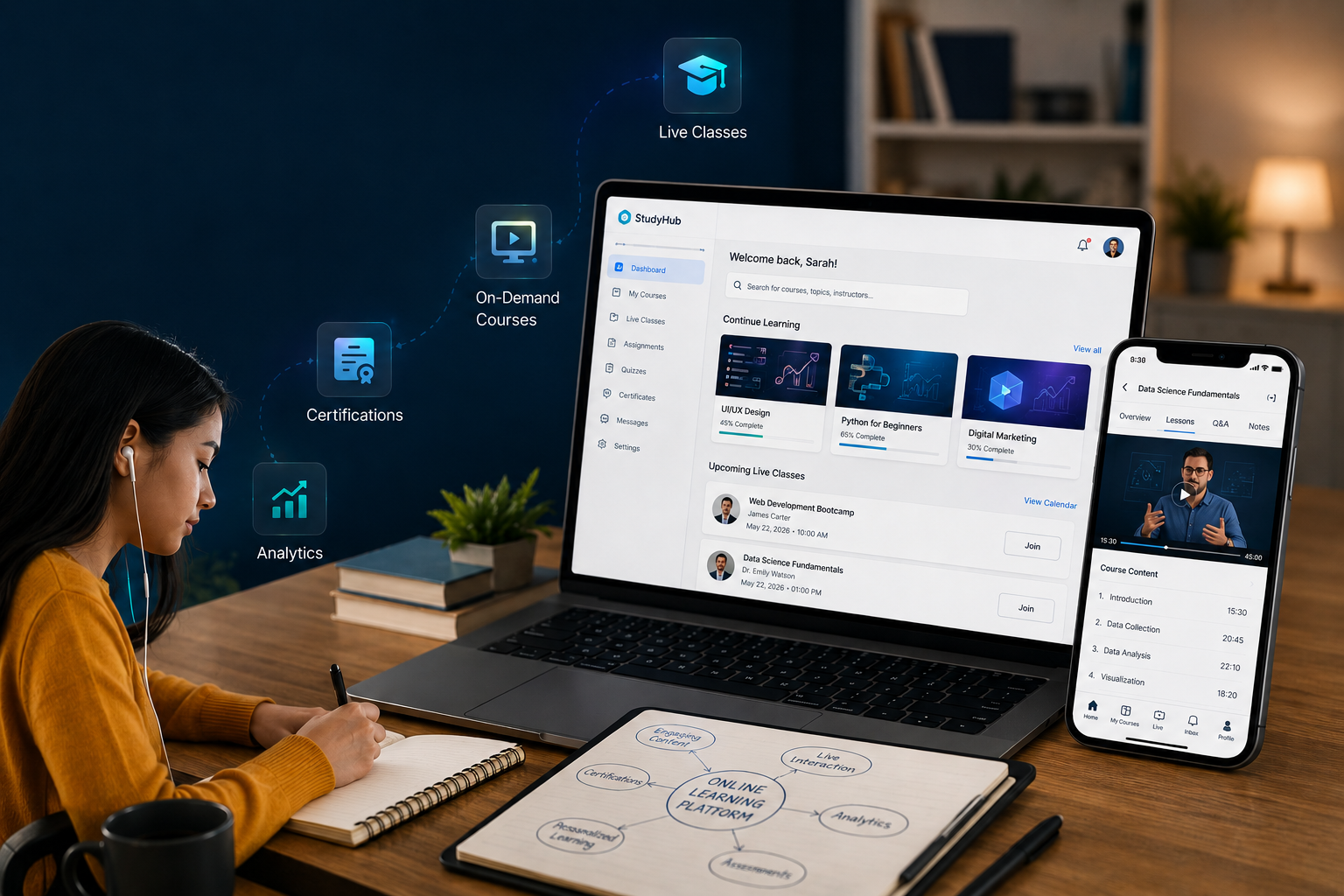
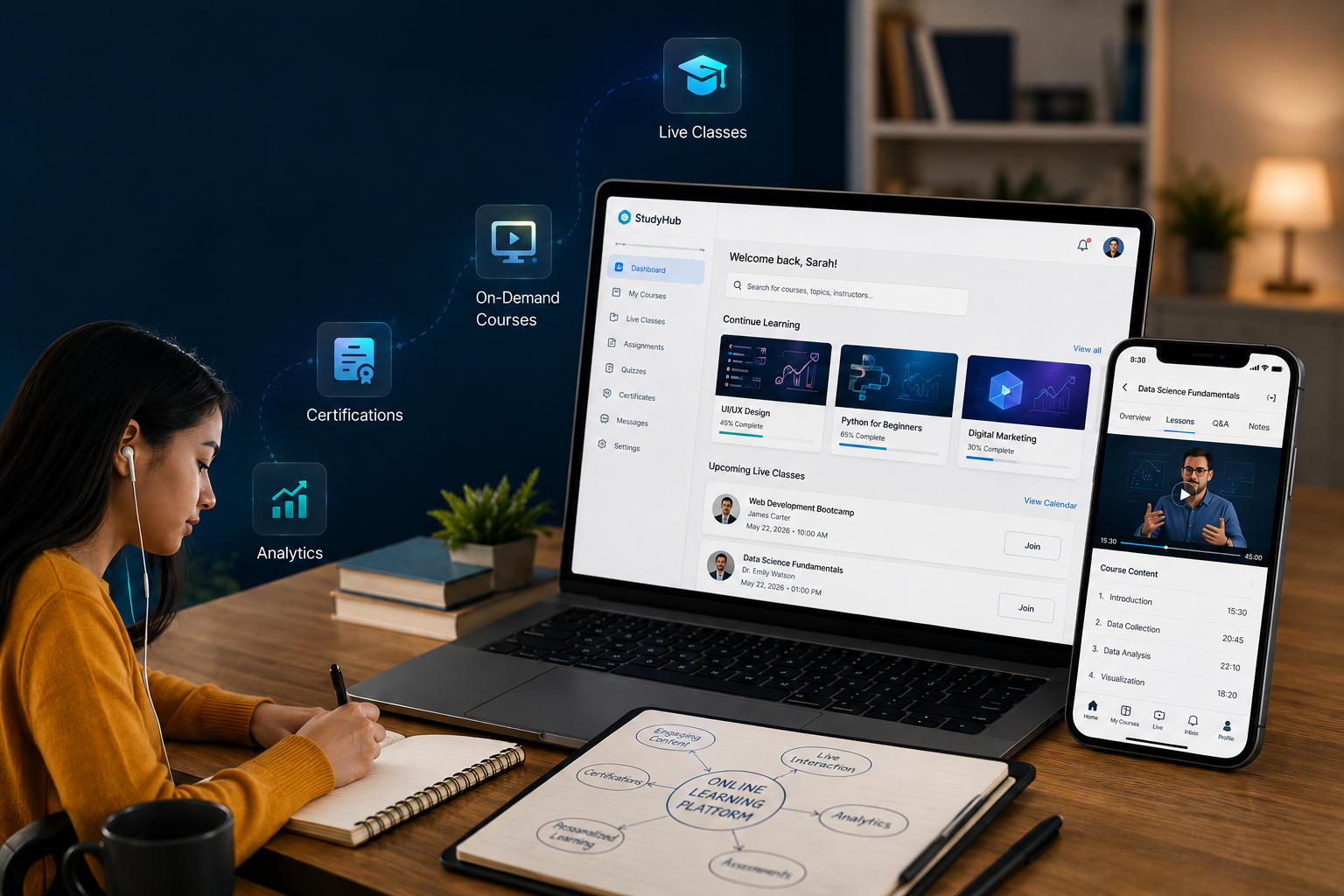
An online learning platform is a digital environment that delivers structured educational content, video lectures, assessments, live sessions, and certifications to learners at scale. Unlike a simple course website, a production-grade platform handles concurrent users, adaptive content delivery, payment processing, progress tracking, and analytics in a unified system.
The case for building in 2026 is stronger than ever. Corporate training shifted decisively toward digital-first delivery post-2020, and it has not reversed. For EdTech founders, that translates directly to a recurring revenue opportunity.
Three market segments are growing fastest right now:
- Corporate upskilling platforms — enterprises replacing classroom training with scalable digital programs
- Professional certification platforms — coding, design, data science, and cloud credentials
- K-12 supplemental learning tools — after-school and tutoring platforms serving parents directly
Each has distinct technical requirements, but the foundational architecture is largely shared. According to HolonIQ's 2025 EdTech Market Report, corporate learning technology alone represents over $50 billion in annual spend globally. If you want to understand the technologies powering this space, our guide on key technologies shaping EdTech is a useful starting point.
Core Features Every Online Learning Platform Needs
Before selecting a tech stack, define the feature set. The minimum viable feature list for a production online learning platform in 2026 includes the following layers.
Content Management and Delivery
- Video upload, transcoding, and adaptive bitrate streaming (HLS/DASH)
- Multi-format content support: PDFs, SCORM packages, interactive HTML5 modules
- Course builder with drag-and-drop lesson ordering
- Drip content scheduling — release lessons on a calendar or completion trigger
- Subtitle and closed-caption support on all video content (WCAG requirement)
Assessment and Progress Tracking
- Quiz engine with multiple-choice, fill-in-the-blank, and video-response questions
- Automated grading with configurable pass thresholds
- Learner progress dashboard — completion percentage, time-on-task, quiz scores
- xAPI/TinCan event emission for enterprise LRS integration
- Certificate generation on course completion with downloadable PDF
User Management and Access Control
- Role-based access: Super Admin, Instructor, Student, Organisation Manager
- SSO integration via SAML 2.0 and OAuth 2.0 (required for B2B sales)
- Multi-tenant architecture for white-label or organisation-partitioned deployments
- Cohort management — groups learners into classes with shared schedules
- Bulk user import via CSV for enterprise onboarding
Communication and Engagement
Engagement features are where platforms differentiate. Discussion forums, live session integration, and automated progress notifications are table stakes. Gamification — points, badges, and leaderboards measurably improves completion rates by 34% per TalentLMS 2024 data. For platforms targeting enterprise learners, AI agents in education are increasingly being used to surface personalised content recommendations and automated coaching nudges.
According to Docebo's Learning Technology Benchmark Report 2024, platforms with AI-driven content recommendations see 2.3x higher course completion rates compared to static catalog platforms.
Our team at Third Rock Techkno has delivered custom EdTech platforms for 50+ clients globally. Talk to us →
Technology Stack for Online Learning Platform Development in 2026
Stack selection is the most consequential decision in online learning platform development. The wrong choice creates scaling ceilings and refactoring debt within 18 months. Here is what the best-performing platforms use in 2026.
Frontend
React or Next.js dominate the frontend for online learning platforms. Next.js is the preferred choice when SEO matters and course catalog pages need to rank organically. Our comparison of ReactJS vs Next.js covers the trade-offs in detail.
For the learner dashboard and player interface, React's component model handles complex state — video position, quiz state, progress bars — cleanly. Pair with TypeScript for type safety across a large component surface. TailwindCSS handles styling efficiently at scale. For the video player, Video.js with HLS.js adapter or Plyr offer reliable cross-browser playback with quality switching. Avoid building a custom player — the edge cases (DRM, subtitles, picture-in-picture, mobile Safari quirks) consume disproportionate engineering time.
Backend
Node.js (Express or Fastify) or Python (FastAPI or Django) are both viable. Node.js wins on real-time features — WebSocket for live sessions, progress sync. Python wins when the platform includes recommendation engines or AI-driven content suggestions, where the data science ecosystem is deeper.
For microservices architecture, separate services handle distinct responsibilities:
- Auth service — registration, login, JWT/session, SSO scaffolding
- Course management service — CRUD for courses, sections, lessons, file uploads
- Video processing service — transcoding, HLS manifest generation, signed URLs
- Notifications service — email, push, in-app progress alerts
- Payments service — Stripe lifecycle, subscription management, invoicing
- Analytics service — event ingestion, reporting, dashboards
Each service communicates via REST or gRPC internally, with an API Gateway (Kong or AWS API Gateway) handling external routing and rate limiting. See authentication and authorisation in a microservices architecture for implementation patterns that avoid the most common security pitfalls.
Database Layer
- PostgreSQL — primary relational store for users, courses, enrollments, and progress records
- Redis — session caching, real-time progress sync, leaderboard data
- Elasticsearch — full-text course search with filters (topic, difficulty, duration)
- S3-compatible object storage (AWS S3 or Cloudflare R2) — video files, thumbnails, certificates
Video Infrastructure
This is where most platforms get it wrong. Storing raw MP4 files and serving them directly fails at scale — the same problem that OTT platform builders face with video delivery.
The correct architecture: upload raw video to S3 → trigger transcoding pipeline (AWS Elemental MediaConvert, Mux, or Cloudflare Stream) → generate HLS manifest with multiple quality renditions (360p, 720p, 1080p) → serve via CDN with signed URLs for DRM protection.
According to Mux's Video Performance Benchmark 2024, platforms using adaptive bitrate streaming see 60% lower buffering rates and 18% higher session completion compared to fixed-bitrate MP4 delivery. Our cloud consulting team recommends building your own pipeline only if you have compliance requirements (on-premise data residency) or extreme cost sensitivity at very high volume.
How to Build an Online Learning Platform: Step-by-Step Architecture
Here is the build sequence that minimises rework and delivers a production-ready platform within 16–20 weeks for a team of 5–8 engineers. For a focused EdTech MVP timeline, this project manager's guide to building your first EdTech MVP walks through the planning phase in detail.
Phase 1 — Foundation (Weeks 1–4)
- Define user roles, content types, and monetisation models before any code is written
- Set up infrastructure: cloud provider, CI/CD pipeline, staging environment, secrets management
- Build auth service: registration, login, JWT/session management, SSO scaffolding
- Build course management service: CRUD for courses, sections, lessons; file upload to S3
Weeks 1–4 should be entirely infrastructure and auth. Resist the urge to build features before the foundation is solid. Teams that skip this phase spend weeks 12–16 refactoring auth because it was bolted on incorrectly.
Phase 2 — Core Learning Experience (Weeks 5–10)
- Integrate video pipeline: transcoding, HLS delivery, player implementation
- Build learner experience: course player, progress tracking, quiz engine, certificates
- Build payments: Stripe integration for subscription or one-time purchase flows
- Implement xAPI event emission and SCORM package hosting
Phase 3 — Admin, Scale, and Launch (Weeks 11–20)
- Build admin dashboard: user management, content moderation, analytics
- Performance and load testing: simulate 5,000 concurrent users before launch
- WCAG 2.1 AA accessibility audit
- GDPR/CCPA compliance review and consent management setup
TRT's product development service follows this exact sequence, validated across 50+ platform builds.
SCORM and xAPI Integration
If your platform targets enterprise clients or corporate training buyers, SCORM 1.2/2004 support is mandatory. SCORM packages are self-contained ZIP archives containing HTML, JavaScript, and a manifest — your platform must parse the manifest, host the package securely, and capture completion and score data via the SCORM JavaScript API.
xAPI (Tin Can) is the modern replacement. It emits structured learning events ("Actor did Verb on Object") to a Learning Record Store (LRS). Implementing xAPI emission from your custom content, in addition to accepting SCORM packages, positions your platform for enterprise deals where the buyer's LRS is already established. For adaptive learning platforms, xAPI event data becomes the raw material for personalisation algorithms.
Third Rock Techkno builds enterprise-grade online learning platforms with SCORM, xAPI, and SSO out of the box. Get a free consultation →
Monetisation Models for Online Learning Platforms
Choosing the wrong monetisation model does not just limit revenue — it shapes the entire product architecture. Three models dominate in 2026.
Subscription (Netflix for Learning)
Learners pay a recurring monthly or annual fee for unlimited access to the course library. This is core SaaS application development territory — the subscription lifecycle, dunning management, and seat-based billing must be built for reliability from day one. Works best for platforms with broad content libraries (100+ courses). Stripe Billing handles the subscription lifecycle cleanly. Expect annual churn of 20–35% in consumer EdTech — retention engineering is the real product challenge.
Per-Course Purchase
Learners pay once per course. Works best for high-value professional certification programs ($200–$2,000 per course). The challenge is discovery — learners must find the right course in the catalog, which makes SEO and paid acquisition the primary growth levers. If you're evaluating top adaptive learning platforms as competitors or benchmarks, most of them use a hybrid of per-course and subscription pricing.
Cohort-Based / Live Cohort Model
Learners join a fixed cohort with a defined start date, deadline, and peer group. Typically charged as a lump sum ($500–$5,000). According to Maven's 2024 Cohort Learning Report, completion rates are 4–6x higher than self-paced courses. Technically, this model requires scheduling infrastructure, live session management, and cohort-scoped discussion spaces.
Enterprise B2B Licensing
Sell seats to organisations. Pricing is per-seat, per-month, negotiated annually. This model requires multi-tenancy, SSO, custom branding, bulk user upload, and aggregate analytics for the organisation admin. Average contract values are 10–50x consumer subscriptions. Our AI education consultation service helps enterprises define the right LMS scope before committing to a build. Invest in SSO (SAML 2.0) and admin reporting early if B2B is in your roadmap.
Performance, Compliance, and Launch Readiness
Platform performance is a learner retention variable — a 1-second delay in video start time increases abandonment by 14% according to Akamai's Media Performance Report. The cost of building an education app rises significantly when performance issues are addressed post-launch rather than designed in from the start.
Performance Targets
These are the benchmarks your platform must hit before accepting real traffic:
- Time to First Byte (TTFB): below 200ms for all API responses
- Video start latency: below 2 seconds on a standard 25Mbps connection
- Core Web Vitals: LCP below 2.5s, CLS below 0.1, INP below 200ms on the course player page
- Concurrent user capacity: load-tested to 5,000 simultaneous learners before launch
- API error rate: below 0.1% under peak load
- Video delivery success rate: above 99.5% across all quality tiers
Compliance Requirements
- GDPR/CCPA — consent management, right-to-erasure workflow, data processing agreements for EU users
- WCAG 2.1 AA — keyboard navigation, screen reader compatibility, captions on all video content
- COPPA — if any content targets users under 13, parental consent flows are legally mandatory
- PCI DSS — never store card data directly; Stripe and Braintree handle PCI scope when integrated correctly
- FERPA — mandatory for any platform serving US K-12 students, governs student record privacy
Pre-Launch Checklist
Our quality engineering team applies the following pre-launch checklist on every platform delivery:
- Penetration test on auth endpoints, file upload, and payment flows
- CDN and caching configured — course pages served from the edge, not the origin
- Automated backup and disaster recovery tested (target RTO below 4 hours)
- Monitoring and alerting: Datadog or Grafana dashboards for API latency, error rate, and video delivery success rate
- Accessibility audit by a screen reader user, not just an automated tool
- Staging environment load test simulating peak concurrent user volume
- Legal review of Terms of Service, Privacy Policy, and data processing agreements
Cost Breakdown: What Does Online Learning Platform Development Cost in 2026?
Cost is consistently the most underestimated variable in EdTech builds. Teams budget for feature development and forget infrastructure, compliance, and quality engineering. According to Clutch's Software Development Cost Report 2025, custom platform development in this category ranges from $40,000 for a constrained MVP to $280,000 or more for a fully featured enterprise system.
Cost Drivers by Component
- Video infrastructure setup — $8,000–$25,000 depending on whether you self-host or use Mux/Cloudflare Stream
- Mobile apps (iOS + Android) — adds 40–60% to the total budget if built natively
- SCORM/xAPI integration — $5,000–$15,000 specialist work
- Multi-tenant architecture — adds 3–5 weeks of backend complexity
- WCAG 2.1 AA accessibility — $3,000–$8,000 for a proper third-party audit and remediation
- Penetration testing — $4,000–$12,000 for a credentialed firm
Ongoing Monthly Infrastructure Costs at Launch Scale
- Hosting (AWS/GCP): $800–$2,500/month for 1,000–5,000 active learners
- Video CDN and storage: $500–$3,000/month depending on watch-hour volume
- Database (RDS + Redis + Elasticsearch): $400–$1,200/month
- Monitoring and logging: $200–$600/month
Our IT consulting team has found that teams consistently underestimate ongoing infrastructure costs. Building a cost model before launch, not after, prevents the margin compression that kills EdTech products in year two.
Building or scaling a learning platform? Third Rock Techkno builds custom learning experience platforms, LMS, and education software — designed around your learners, content and integrations, not a rigid off-the-shelf template. Book a free scoping call.
Conclusion
Building a scalable online learning platform in 2026 is an architectural challenge first and a feature challenge second. The platforms that win are not the ones with the longest feature list — they are the ones whose video delivery does not buffer, whose progress tracking does not lose data under load, and whose admin dashboard gives instructors real insight into learner behaviour.
Start with a clearly defined monetisation model and user role structure. Build infrastructure before features. Invest in video pipeline quality early — it is the hardest component to refactor later. Plan for enterprise requirements (SSO, multi-tenancy, xAPI) even if your launch is consumer-focused, because the B2B opportunity will come.
Our deep dive into EdTech startup challenges covers the growth-stage pitfalls that catch most platform founders off guard. Third Rock Techkno has delivered custom software solutions for clients across corporate training, professional certification, and K-12 markets. If you are at the planning stage or looking to scale an existing platform, the product development process outlined here will save you six months of rework.
Ready to Build Your Online Learning Platform?
From architecture design to production deployment, TRT engineers have delivered 50+ EdTech platforms across corporate training, professional certification, and K-12 markets.