Build vs Buy Adaptive Learning Platform: A Decision Framework for 2026
Build vs buy adaptive learning in 2026: compare DreamBox, ALEKS, and Knewton vs a custom build, with real costs and a clear decision framework.

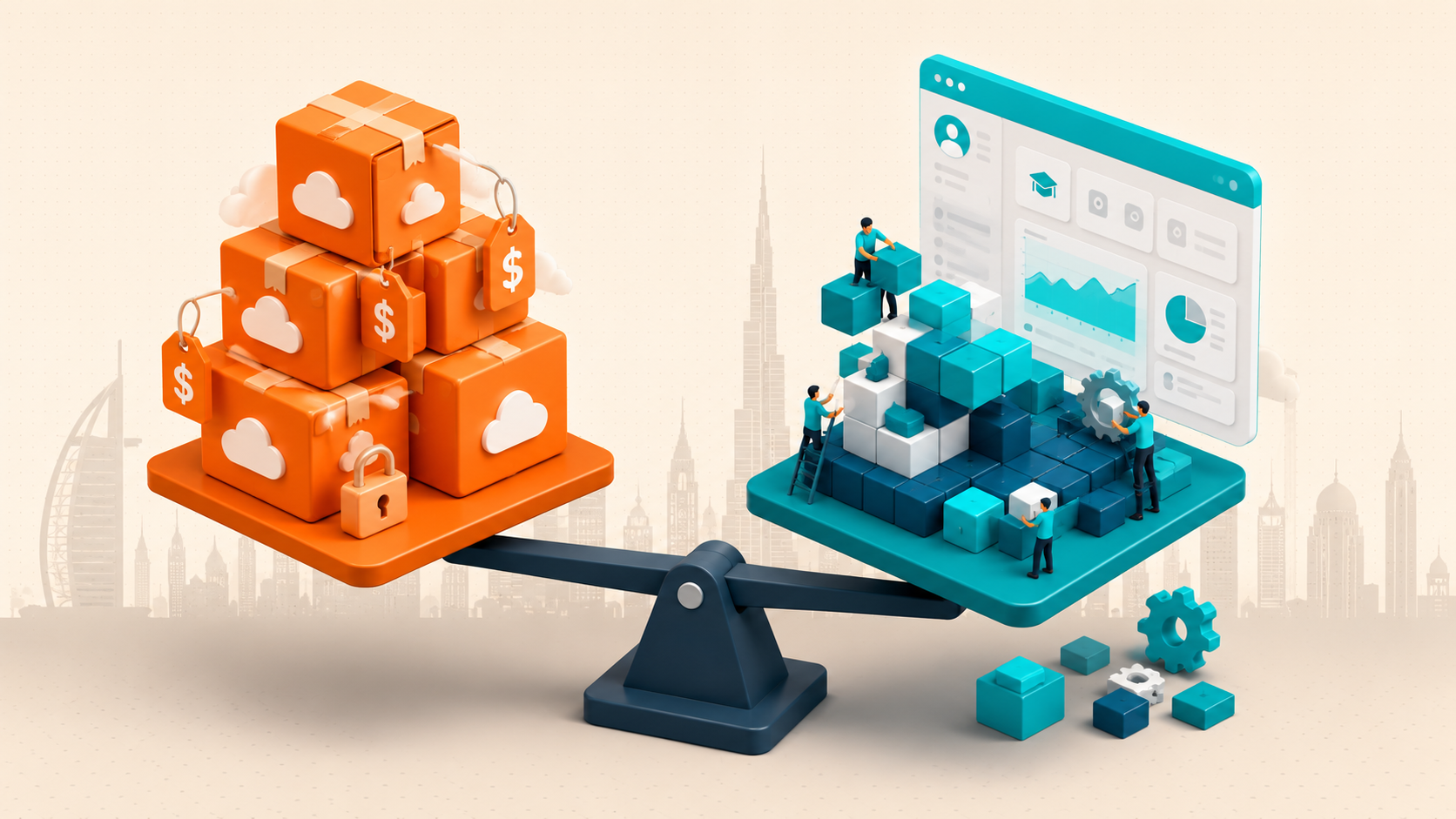
Most build-versus-buy debates end with "it depends," which helps no one. So let's make it specific. Build vs buy adaptive learning comes down to one question: is the adaptive engine a feature you consume, or the product you sell? For a school buying math remediation, a proven platform is the right call.
For an EdTech company whose whole pitch is a smarter learning path, renting someone else's algorithm is renting your own differentiator. The stakes are rising because the market is: the adaptive learning software market is on track from $2.97 billion in 2026 to $12.15 billion by 2035, per Precedence Research.
Adaptive learning also works, with 86% of recent studies reporting positive effects on achievement. This guide compares the leading off-the-shelf platforms, shows the exact signals that mean you've outgrown them, and gives you a decision framework instead of a shrug. Let's start with why the question got harder this year.
- Adaptive learning works: 86% of recent studies report positive effects, and DreamBox shows 2.5x math growth versus traditional methods.
- Buy when your subject and pedagogy are standard; DreamBox, ALEKS, and Knewton each own a clear niche.
- Build when the adaptive logic is your differentiator, you need data ownership, or your content does not fit a vendor's template.
- Agentic AI has cut custom-build costs, so building is more viable in 2026 than it was even a year ago.
- A custom adaptive engine is real engineering: mastery modeling, a learning record store, a feature store, and a recommendation engine, not a wrapper on ChatGPT.
Quick answer
Whether to build or buy an adaptive learning platform depends on how unique your learning model is, plus your budget, timeline and integration needs. Off-the-shelf tools launch fast and cost less upfront; a custom build fits unique pedagogy, gives full data ownership, and scales on your terms. This 2026 guide breaks down the trade-offs.
Why the Build vs Buy Question Got Harder in 2026
For years the answer was simple: buy, because building an adaptive engine was too expensive and too risky. That default is breaking down, and two forces are behind it.
The math changed on both sides of the decision at once, which is why more teams are genuinely torn this year rather than defaulting to SaaS.
Building Got Cheaper
Agentic AI has collapsed a chunk of custom-build cost. Teams now ship working software faster than they could a year ago, which lowers the floor on what a custom adaptive platform costs to stand up.
That does not make building trivial. It makes building an option for organizations that would have dismissed it in 2024 as too rich for their budget.
Buying Got Better, and More Locked-In
Off-the-shelf platforms also improved, and their outcome data is strong. The pull toward buying is real when a proven engine already fits your subject.
The result is a genuine decision rather than a foregone one. To make it well, you need to know what the leading platforms actually do.
The Best Off-the-Shelf Adaptive Learning Platforms in 2026
Before you consider building, know what you'd be replacing. Three platforms dominate the off-the-shelf conversation, and the useful news is that each owns a distinct niche rather than competing head to head.
This is the honest version of a custom adaptive learning vs DreamBox, ALEKS, and Knewton comparison, which matters because picking the wrong reference point distorts the whole build-versus-buy math.
DreamBox: K-8 Math, Proven and Affordable
DreamBox, now part of Discovery Education, is an adaptive math curriculum for K-8. It starts with a diagnostic, then builds a personalized path, adjusting difficulty in real time.
Its evidence is strong. An impact study across 8,000 schools and 3 million students found a clear pattern. Learners completing at least five lessons a week improved their NWEA MAP percentile by an average of 9.9 points. At roughly $20 per student per year, it is hard to beat for its lane, but it is K-8 math only.
ALEKS: Math and STEM Mastery for Higher Ed
ALEKS, a McGraw Hill product, is the go-to for math placement and remediation, especially in higher education. It uses a mastery-learning model with continuous re-measurement to pick each next question.
Universities including Arizona State and Washington State use it at scale, with documented gains in course pass rates. If your need is STEM mastery on a standard curriculum, ALEKS is tough to justify rebuilding.
Knewton Alta: Adaptive Courseware for Higher Ed
Knewton Alta delivers adaptive courseware for higher education, using knowledge modeling that updates skill mastery to select the next problem. It bundles with Wiley courseware, and Knewton has reported roughly a 23% lift in learning outcomes.
The pattern is clear: these platforms are excellent inside their lane and unavailable outside it. That boundary is exactly where the build conversation begins.
Not sure whether a platform actually fits your use case?
We help schools and EdTech teams map their real requirements before they buy or build. No sales pitch, just the honest fit analysis.
Talk to us

When Off-the-Shelf Adaptive Learning Isn't Enough
Here's the section the vendor demos skip. Off-the-shelf adaptive learning is a great deal until it isn't, and the isn't arrives for specific, predictable reasons. If two or more of these describe you, buying will cost you more in workarounds than building would.
None of these are edge cases. They are the normal reasons organizations outgrow a template.
The Signals You've Outgrown SaaS
Watch for these, because each one is a place where a vendor's template stops fitting your reality.
- Your subject or pedagogy is nonstandard. DreamBox does K-8 math beautifully and nothing else. If you teach vocational skills, languages, or a custom competency framework, no off-the-shelf engine covers it.
- The adaptive logic is your product. If you're an EdTech company selling smarter learning, renting the algorithm means renting your differentiator, and your investors will notice.
- You need to own the data and the model. Regulated sectors, government contracts, and data-residency rules often rule out sending learner data into a shared vendor cloud.
- Integration runs deep. When adaptive learning has to plug into your SIS, your assessment engine, and your analytics stack as a native part of the system, bolt-on connectors buckle.
- Per-learner fees have outgrown a build. At large scale, SaaS licensing can exceed what owning the platform would cost, especially over five years.
The Cost of Forcing a Fit
Buying the wrong platform rarely fails loudly. It fails as a slow accumulation of workarounds, exports, and manual steps that quietly erode the efficiency you bought it for.
That hidden cost is why the decision deserves a framework, not a gut call. If any of these signals hit home, the next question is what building actually involves.
What Building a Custom Adaptive Engine Actually Requires
Building custom does not mean wrapping ChatGPT in your logo. A real adaptive engine is a system with several specialized parts, and knowing them protects you from vendors who oversimplify.
This is where product heads earn their title, because the architecture decisions here shape everything downstream.
The Core Components
A production adaptive platform needs these working together, not a single clever model.
- A mastery model that estimates what each learner knows and updates continuously as they respond.
- A learning record store (LRS) that captures every interaction as structured data you own.
- A feature store that turns raw interactions into the signals the model actually uses.
- A recommendation engine that selects the next best item for each learner in real time.
- A content and authoring layer so subject experts can add and tag material without engineers.
The Part Teams Underestimate
The algorithm gets the attention, but the content and data pipeline is where custom builds succeed or stall. Adaptive learning is only as smart as the tagged, structured content feeding it.
This is also the honest case for a partner who has built these systems before. Assembling mastery modeling, an LRS, and a recommendation engine from scratch is slow and expensive to learn on the job. Our guide to custom AI education platform development breaks down that build in detail.

The Real Cost and Timeline of Build vs Buy
Cost is where the decision gets concrete, and where vendors on both sides get optimistic. Here is the honest 2026 picture for an adaptive platform specifically.
Buying looks cheaper on day one and can stay cheaper at small scale. Building costs more upfront and wins on control and, eventually, on total cost at scale.
The Numbers That Matter
Use these as planning bands, since every adaptive build varies with subject depth and integration count.
- Off-the-shelf: from about $20 per student per year (DreamBox) up to $300 to $600 per user per year for legacy enterprise platforms, billed per learner.
- Custom adaptive MVP: roughly $2,000 to $5,000 for a focused engine, one subject, and core integrations.
- Full custom adaptive platform: about $10,000 to $40,000 or more with multi-subject support, deep integrations, and a mature content pipeline.
- Custom content: budget separately, since quality adaptive content runs into the thousands of dollars per finished hour.
The break-even logic is simple. When your annual per-learner SaaS bill approaches the amortized cost of owning a platform, and you need control anyway, building stops being the expensive option. Worth noting: 95% of higher-ed institutions cite high implementation cost as a barrier, so budget honestly on either path.
Bring us your learner count and requirements. We will model buy, build, and hybrid side by side, with real figures. Talk to our team →
The Build vs Buy Decision Framework
Enough context. Here is the framework to actually decide. The core question is not cost, it is whether the adaptive engine is something you consume or something you differentiate on.
Match your situation to the path below, and be honest about which row you're really in.
The hybrid row is where a growing number of teams land: license a proven component where the subject is standard, and build the part that differentiates. It is the pragmatic answer the "it depends" crowd never quite gets to.
When the Hybrid (Blend) Path Wins
Blend is not a hedge; it is a sequencing decision. You license a proven engine where the subject is standard and commodity, then build only the layer that sets you apart, on your own timeline. It gets you to market in weeks instead of quarters, and it caps the risk: you are not betting the launch on an unproven in-house algorithm.
Two examples make it concrete. A K-12 company can run DreamBox or ALEKS for core math remediation while building its own analytics and parent-facing layer on top, the parts buyers actually compare it on. An enterprise L&D team can buy the adaptive delivery and pour its budget into proprietary content and skills-taxonomy mapping instead. In both cases, you rent the part nobody differentiates on and own the part that wins deals.
Pros and Cons of Building Custom Adaptive Learning Software
To close the loop, here is the honest ledger. Building custom is powerful and not for everyone, so weigh both columns before you commit budget.
The pros and cons of building custom adaptive learning software come down to control versus speed, the same trade-off at the heart of every build-versus-buy call.
The Pros
- Full ownership of the model, the data, and the roadmap, with nothing gated behind a vendor's tier.
- Exact fit to your subject, pedagogy, and integrations, with no forcing a template.
- A real differentiator if adaptive learning is what you sell, not just what you use.
- Lower total cost at scale, since you stop paying per-learner fees that grow with enrollment.
The Cons
- Higher upfront cost and time than signing a SaaS contract this quarter.
- Ongoing ownership, since you maintain and improve the platform after go-live.
- Content is on you, and adaptive content is expensive to author well.
- You need the right partner, because a generalist team learning adaptive systems on your budget is the most expensive path of all.
By 2026, the build vs buy adaptive learning decision has become a real strategic choice rather than a default, because building is cheaper than it was and buying is more capable than ever.
Three things should anchor your call. First, decide whether the adaptive engine is something you consume or something you differentiate on, since that answers most of the question. Second, price the whole picture, including per-learner fees at scale and the content pipeline on the build side.
Third, respect the architecture, because a real adaptive engine is mastery modeling, a learning record store, and a recommendation engine, not a chatbot in a costume.
Get those right, and you'll buy or build a platform that actually fits. If you want a partner to model the decision or build the custom engine when that's the smarter call, our team can help through Third Rock Techkno's EdTech and custom software services, or you can simply contact us to map your build-vs-buy plan.
Planning an adaptive learning platform? Third Rock Techkno builds AI-driven learning experience platforms and education software with adaptive engines tailored to your learners and curriculum. Book a free scoping call.