Best LMS for Corporate Training in 2026: AI-Powered Platforms and Custom Build Options
The best LMS for corporate training in 2026: AI platforms compared, plus when a custom build beats SaaS. A buy-vs-build guide for L&D, HR, and CLOs.

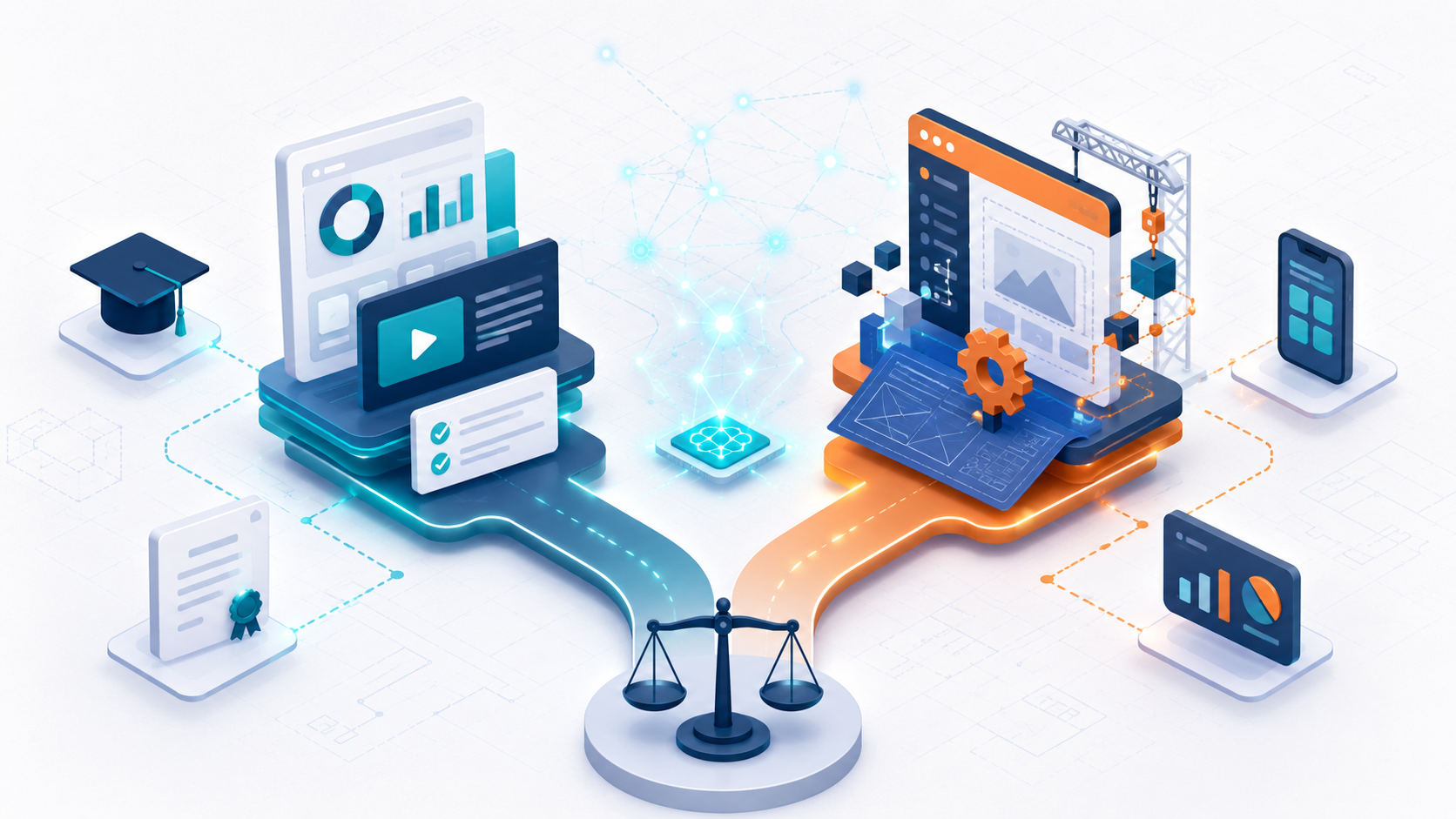
Most LMS shortlists start with a list of vendors. That's the wrong place to start. The best LMS for corporate training isn't a single product, it's the right answer to "buy or build" for your headcount, your compliance load, and your five-year budget. According to Precedence Research, the corporate LMS market grows from $17.47 billion in 2026 to $72.30 billion by 2034.
That means more vendors, louder AI claims, and more ways to overspend. For an L&D manager, HR director, or CLO, the stakes are real. Pick the wrong platform and you'll either pay per-user fees that balloon as you scale, or build something you didn't need.
This guide does both halves of the job. It compares the leading AI-powered platforms, then walks through exactly when a custom build beats SaaS. Let's start with what actually matters in an evaluation.
- The corporate LMS market reaches $17.47 billion in 2026 and grows at nearly 20% a year, per Precedence Research.
- Docebo, 360Learning, and Cornerstone lead the SaaS field, each strong at a different job: integrations, collaboration, and compliance.
- AI can cut 20 to 30% of L&D operating costs, per Korn Ferry, but only about 12% of platforms are true AI leaders today.
- Compliance is the number one driver of LMS adoption, cited by roughly 73% of organizations.
- Custom builds typically break even once SaaS licensing hits $100,000 to $150,000 a year, often around the 5,000-user mark.
Quick answer
The best LMS for corporate training in 2026 depends on your team size, content types and integrations — but the strongest options share mobile learning, SCORM/xAPI support, analytics, automation, and SSO/HRIS integration. This guide compares the leading platforms and shows when a custom LMS beats an off-the-shelf one.
What L&D Leaders Actually Need From a Corporate LMS in 2026
Before any vendor demo, get clear on the jobs your LMS has to do. Buyers who start with features end up dazzled by demos. Buyers who start with jobs end up with a platform that fits.
For most enterprises, the same handful of needs decide the outcome. Miss one and adoption quietly stalls a quarter after launch.
The Non-Negotiables
These are the requirements that, when missing, turn into a migration project within two years.
- Compliance tracking and reporting: automated certification, audit trails, and renewal alerts, since compliance is the top reason companies buy.
- Mobile-first delivery: a real app experience, because mobile now drives most learning sessions.
- Integrations: clean connections to your HRIS, SSO, and content tools, not a brittle export-import dance.
- AI personalization: adaptive paths and recommendations that route the right training to the right person.
- Analytics that a CLO can present: dashboards tied to business outcomes, not just course completions.
The Numbers That Should Shape Your Shortlist
Three data points reframe what "good" looks like, and most vendor decks won't volunteer them.
With the jobs defined, the vendor list gets a lot easier to read. Here's how the leaders stack up.

The Best Corporate LMS Platforms in 2026
Three platforms dominate enterprise shortlists, and the useful news is that they're strong at different things. Picking well is less about which is "best" and more about which job you're hiring it for.
This is the heart of any AI-powered corporate LMS comparison between Docebo and 360Learning, so here's the honest version, with Cornerstone added for the compliance-heavy crowd.
Docebo: The Integration and Monetization Pick
Docebo positions itself as an AI-powered platform that consolidates internal, customer, and partner training in one place. Its AI handles content tagging, automatic translation, course recommendations, and a chatbot.
Its real edge is breadth. Docebo connects to more than 400 tools across HRIS, CRM, content authoring, and eCommerce, which makes it the strong pick if you also want to sell courses or train external audiences.
360Learning: The Collaborative-Culture Pick
360Learning is the AI-driven choice for organizations that want to capture internal expertise. Its collaborative Academies and co-authoring let employees create and share training, not just consume it.
It carries a user sentiment rating of 92 across more than 1,300 reviews, which is unusually high for enterprise software. If your goal is a learning culture rather than a content library, it fits.
Cornerstone: The Compliance and Talent Pick
Cornerstone shines when the LMS has to do more than train. Its strength is real-time compliance reporting with dynamic dashboards, plus tight integration with performance management and succession planning.
AI in Corporate LMS: What's Real and What's Marketing
Every LMS now has an AI badge on its homepage. Some of it earns the badge, and some of it is autocomplete with ambition. Knowing the difference saves you from paying a premium for a feature you won't use.
The demand is real. Over 80% of LMS buyers want embedded AI, yet only about 12% of platforms qualify as genuine AI leaders, which means the marketing is running ahead of the engineering.
AI Features That Actually Save Time
These are the capabilities that change an L&D team's week, not just a sales slide.
- Automated content creation and tagging: turn documents into structured courses and keep a library searchable.
- Adaptive learning paths: route each employee to the training they actually need next.
- AI translation and localization: scale compliance training across regions without a translation vendor.
- Skills analytics: map who knows what, and where the gaps sit before they become risks.
The Honest Caveat
AI can save 20 to 30% of L&D operating costs through automation, per Korn Ferry, but only when it's pointed at real work. An AI chatbot that reskins your FAQ won't move that number.
The teams getting the savings are the ones automating content production, grading, and reporting. That's also the line where buying an off-the-shelf model sometimes stops being enough, which leads to the build-versus-buy question.

Compliance, Onboarding, and Mobile: The Three Jobs That Decide Adoption
A corporate LMS lives or dies on three unglamorous jobs. Get these right and the platform sells itself internally. Get them wrong and you'll be re-evaluating within 18 months.
Each one has a number attached that should shape your decision.
Compliance and Onboarding
Compliance is the top adoption driver for a reason: the cost of getting it wrong is regulatory, not just operational. An LMS for compliance and onboarding training in enterprises needs automated tracking, audit-ready reporting, and certification renewals built in.
Onboarding is where the ROI shows up fastest. Structured onboarding improves new-hire retention by about 82%, and a good LMS cuts onboarding time by roughly 25%. That's a finance conversation, not just an HR one.
Mobile and Remote Teams
For distributed workforces, mobile isn't a feature, it's the channel. The best mobile LMS for remote corporate training teams has to deliver a real app experience, not a shrunk-down web page.
The data backs the urgency. Learners on smartphones complete courses 45% faster, yet 24% of LMS users are dissatisfied with platforms that lack proper mobile support. A weak mobile experience is a slow adoption leak.

Custom Corporate LMS vs Buying Enterprise SaaS
Here's the decision the vendor shortlists are designed to make you skip. For some organizations, the best LMS for employee training and development in 2026 isn't on any vendor's pricing page, because it's custom.
The tradeoff is simple to state and easy to get wrong. SaaS is faster to launch and cheaper upfront. Custom gives you full control and lower cost at scale. The trick is knowing where your organization sits.
The Break-Even Math
Custom LMS development runs roughly $10,000 to $50,000 for an enterprise-grade build, and $50,000 to $80,000 for a full-featured platform with deep integrations, plus $5,000 to $10,000 a year to maintain.
SaaS looks cheaper until your user count climbs. The break-even point typically arrives when annual licensing hits $30,000 to $50,000. For organizations above 5,000 users, custom often breaks even within three to four years, with lower total cost over a 5-to-10-year horizon.
For a deeper cost breakdown, our guide to custom LMS development companies maps build options and pricing in detail. The short version: build when control and scale matter more than launch speed.
Not sure which side of the break-even line you're on?
Bring us your user count and your current LMS bill. We will model buy versus build with real numbers, not a sales pitch.
Talk to our team
How to Choose: A Buyer's Shortlist
A structured evaluation beats a great demo every time. Demos are built to impress, so run every option through the same checklist instead.
Use this sequence and the right answer usually surfaces on its own.
- Document your real requirements, including compliance rules and the integrations you actually use.
- Count your users and project growth, because per-seat pricing changes the math fast.
- Pressure-test the AI, asking what it automates rather than what it's called.
- Score the mobile experience on a real device with a real course.
- Model three-year total cost for SaaS and for custom, side by side.
- Check data ownership and exit terms, so you're never trapped by your own training data.
The platform that wins this checklist is rarely the flashiest one. It's the one that fits your numbers, which is the whole point of doing the work before the demo.
By 2026, the best LMS for corporate training is less about a logo and more about a decision: buy the speed of SaaS, or build the control and economics of custom. Three things should guide your next step.
First, define the jobs before you watch a single demo, since compliance, mobile, and onboarding decide adoption. Second, treat AI claims as a question, not a feature, and ask what each tool actually automates.
Third, run the break-even math, because past roughly $50,000 in annual licensing, building often wins. Get those right and you'll buy or build a platform your people actually use.
If you want a partner who can compare options honestly and build a custom LMS when that's the smarter call, our team can help through Third Rock Techkno's eLearning and LMS development services, or you can contact us to model your decision.
Building or scaling a learning platform? Third Rock Techkno builds custom learning experience platforms, LMS, and education software — designed around your learners, content and integrations, not a rigid off-the-shelf template. Book a free scoping call.