How to Modernise Your School ERP System With AI in the UAE and Saudi Arabia
A practical guide to AI school ERP modernisation in the UAE and Saudi Arabia: what to upgrade, what to build, PDPL compliance, and how to pick a partner.

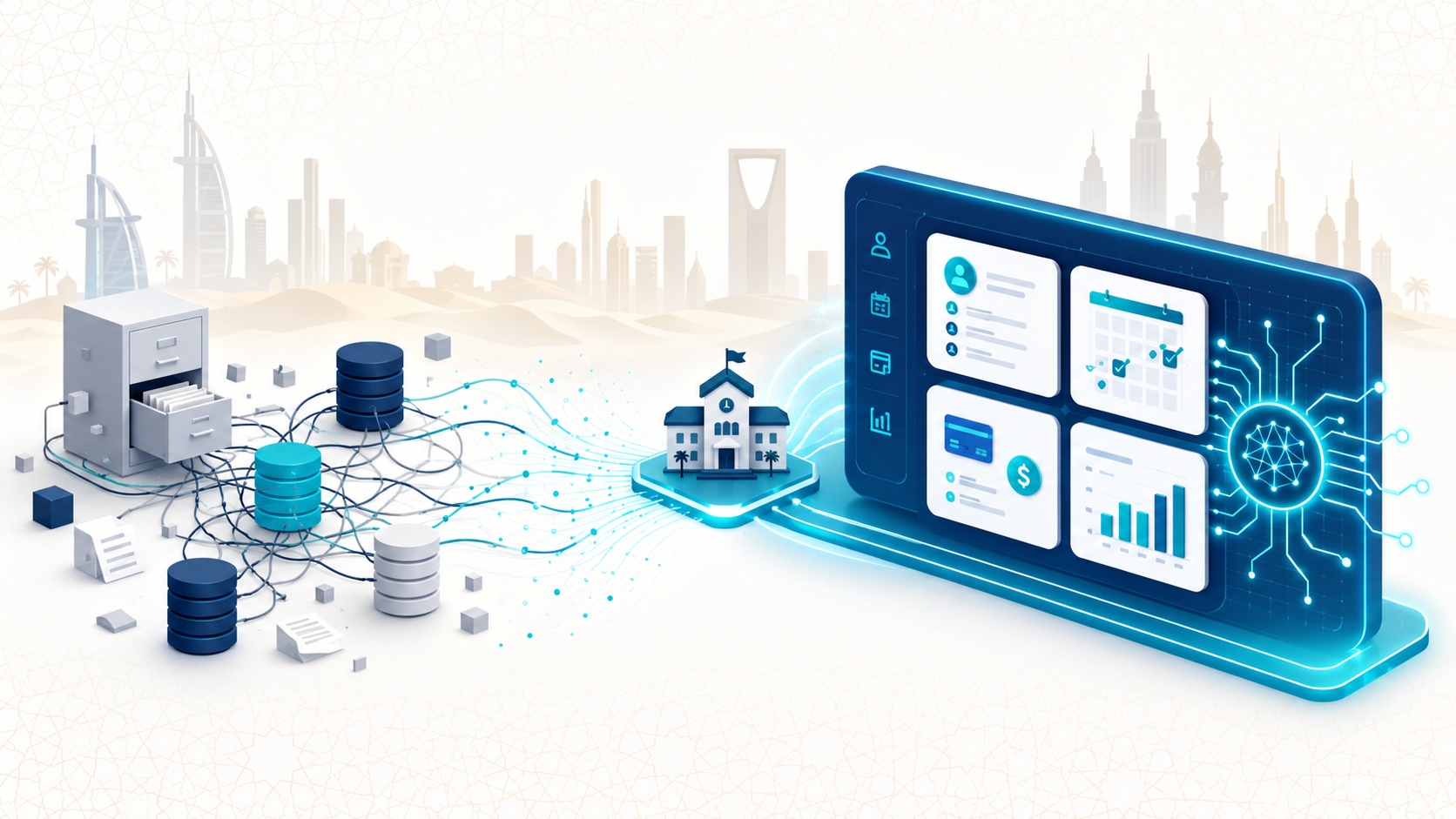
If your school still runs admissions in one system, attendance in another, and finance in a spreadsheet only the bursar understands, you already know the problem. AI school ERP modernisation in the UAE and Saudi Arabia has moved from a long-term ambition to a near-term requirement, and the timing isn't optional. From August 2026, UAE government and Ministry of Education-curriculum schools must deliver AI education from KG to Grade 12, and private schools have been told to expect alignment.
Meanwhile the GCC EdTech market reaches roughly $3 billion in 2026, and the systems running most schools weren't built for any of it. According to EDUCAUSE research, more than 70% of education leaders name legacy systems and data fragmentation as the top barriers to institutional agility.
For an IT director or CTO at a private school or multi-campus group, the question isn't whether to modernise, it's how to do it without breaking what works. This guide walks through exactly that. Let's start with why the clock is running.
- The UAE mandates AI education KG to Grade 12 from August 2026, pushing schools to modernise the systems behind it.
- Over 70% of education leaders cite legacy systems and data fragmentation as the top barrier to agility, per EDUCAUSE.
- Disconnected school platforms can add 30 to 40% operational inefficiency during peak cycles like admissions and exams.
- UAE PDPL fines reach AED 5 million for student-data violations, so compliance has to lead the project, not trail it.
- Most schools should modernise in phases, not rip-and-replace, and the buy-upgrade-build choice depends on how unusual your workflows are.
Quick answer
Modernizing a school ERP with AI in the UAE and Saudi Arabia adds automation, predictive insights and Arabic-first communication to legacy systems. In 2026 it cuts admin, improves parent engagement and supports compliance. This guide covers the upgrade path and what to prioritize.
Why GCC Schools Can't Put Off ERP Modernisation Anymore
For years, an ageing school ERP was a tolerable annoyance. In 2026, it's a liability, because the expectations around it changed faster than the software did. Three forces turned a someday project into a this-year one.
The pressure is regional and specific, not a vague digital-transformation slogan. It comes with dates, mandates, and budgets attached.
The Mandate Pressure
The UAE Cabinet approved a mandatory AI curriculum in May 2025, and from August 2026 it applies across government and MoE-curriculum schools from KG to Grade 12. The 2026-2027 teaching plan even formalises a new subject, Artificial Intelligence and Technology.
Saudi Arabia moved in parallel, rolling out an AI curriculum to more than six million students for the 2025-26 year. When the curriculum assumes digital delivery, the back-office systems have to keep up or the gap shows.
The Market Pressure
This isn't a fringe trend. The GCC EdTech market reaches around $3 billion in 2026, and the UAE and Saudi Arabia together account for roughly 70% of regional revenue.
The Competitive Pressure
Parents in the UAE and Saudi Arabia now compare schools on digital experience, not just results. Groups like GEMS Education are partnering with enterprise vendors to prepare students for an AI economy, which raises the bar for everyone else.
A modern ERP is how you keep pace without hiring an army. The next question is what "modern" actually buys you.

What "AI-Powered" Actually Means in a School ERP
Every vendor now stamps "AI-powered" on the brochure. Some of it is real automation, and some is a chatbot in a blazer. Knowing the difference protects your budget and your evaluation time.
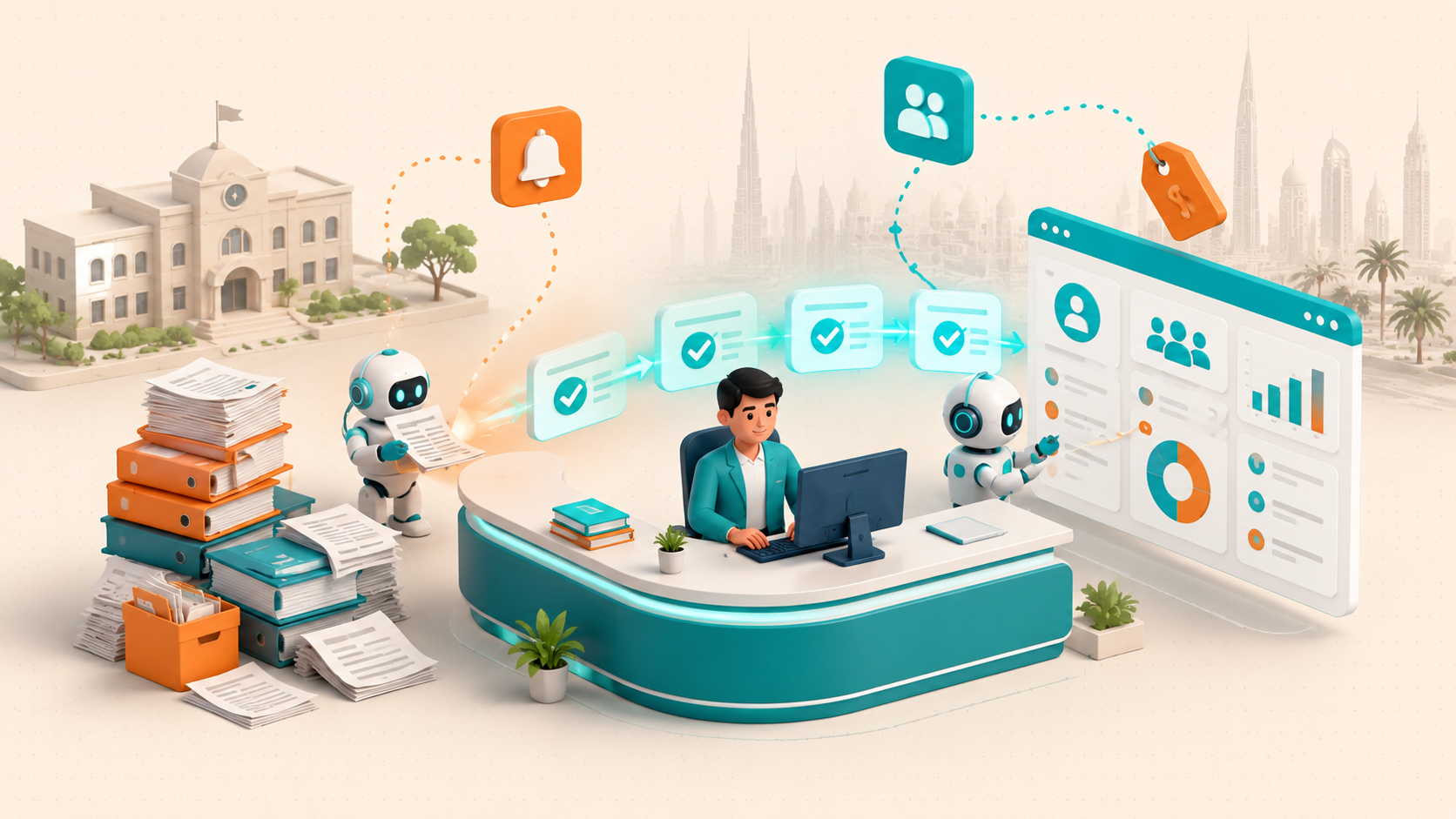
A genuinely AI-enabled school ERP does work your staff currently do by hand. It doesn't just store data, it acts on it.
The Features That Earn Their Place
These are the capabilities that change an operations team's week, not just the sales demo.
- Predictive student insights: flag learners at risk of dropping attendance or grades before it becomes a parent meeting.
- Workflow automation: handle admissions, fee reminders, and approvals without manual chasing.
- Natural-language reporting: ask "show me unpaid fees in Year 7" and get an answer, not a query builder.
- Smart scheduling: resolve timetable and resource clashes that used to eat a week each term.
- Automated compliance reporting: generate the records inspectors and ministries expect, on demand.
What to Treat With Suspicion
Not every AI label is doing real work. A reskinned FAQ bot or a dashboard that just renames "reports" as "insights" is not modernisation.
The test is simple: does the feature remove a task a human does today, or just add a screen? An AI-powered school management system in the UAE should give your team back hours, not new tabs to check. That value only shows up, though, once you understand what the old system is quietly costing.
The Real Cost of Legacy and Fragmented School Systems
The strongest case for modernisation isn't the new features, it's the hidden bill you're already paying. Legacy and disconnected systems leak money and time in ways that rarely show up on one invoice.
Most schools underestimate this because the cost is spread across departments. Add it up and the picture changes.
Where the Money Actually Goes
Fragmentation has a price, even when every individual tool looks affordable.
- Peak-cycle overload: institutions on disconnected platforms face 30 to 40% higher operational inefficiency during admissions and exam periods, per sector research.
- Double data entry: the same student detail typed into three systems is three chances to get it wrong.
- Reporting delays: pulling a board or ministry report becomes a manual export marathon.
- Integration debt: every new tool bolted onto an old core adds fragility, not capability.
The Risk That Isn't on the Balance Sheet
There's a quieter cost too. Fragmented systems make data security and compliance far harder, because you can't protect what you can't see in one place. For schools handling minors' data, that's not a small exposure.
That's also why modernisation and compliance belong in the same project, a point we'll return to. First, the practical question every IT director asks: how do you actually do this without chaos?
We map a school's current stack and quantify the waste before recommending a single change. Talk to us →
Your School ERP Modernisation Roadmap
The biggest mistake schools make is treating modernisation as a single dramatic switch-over. The schools that succeed run it as a phased programme, where each stage delivers value and reduces risk before the next begins.
Here's the sequence we'd run with a UAE or Saudi school group preparing to upgrade legacy systems. The order matters more than the speed.
Where AI Fits in the Roadmap
AI isn't a phase, it's a layer you add once your data is clean and connected. Predictive insights and automation only work when the underlying records are unified, which is why the audit in phase one matters so much.
Trying to bolt AI onto fragmented data is how schools end up with confident, wrong predictions. Get the foundation right and the intelligence follows. Our guide to AI SIS integration for UAE schools goes deeper on the upgrade-without-replacing approach.

Buy, Upgrade, or Build: Choosing Your Path
This is the decision that defines your budget and your timeline. There's no universally right answer, only the right answer for your school's size, workflows, and ambitions.
The trap is letting a vendor make this choice for you. Each path fits a different situation, so be honest about yours.
Multi-campus groups in the UAE and Saudi Arabia most often land on a hybrid: a custom core that fits their structure, with proven modules plugged in where standard works. The deciding factor is rarely cost alone, it's how much your operations differ from the template a SaaS vendor assumed.

PDPL and Compliance: The Part Most Vendors Skip
Here's the section the glossy demos rush past. In the UAE and Saudi Arabia, a school ERP handles minors' data, and that makes compliance a design requirement, not a checkbox at the end.
Get this wrong, and the cost isn't just technical; it's regulatory and reputational. Build it in from phase one, and it stops being a blocker.
What UAE PDPL Requires From Your Systems
The UAE's Federal Decree-Law No. 45 of 2021 (PDPL) applies to schools and EdTech platforms processing the data of UAE residents, with enhanced protections for minors and families.
- Lawful consent, especially for minors, with proper parental consent flows built in.
- Transparency about what data you collect and why.
- Security controls and cross-border transfer rules, which matter when your data lives in foreign clouds.
- A clear data map, so you can show where every record sits when asked.
The penalties are real: UAE PDPL allows administrative fines up to AED 5 million for serious violations. Saudi Arabia operates its own PDPL framework with comparable expectations, so a regional group has to satisfy both.
Why Modernization Makes Compliance Easier
Counterintuitively, the upgrade is your compliance opportunity. A unified, modern ERP lets you see and govern data in one place, which fragmented legacy tools never allowed.
That single-source-of-truth is the difference between a one-hour audit response and a one-week scramble. It's also why the choice of implementation partner matters so much.
We design school systems with UAE and Saudi data rules built in from day one, not patched on later. Talk to our team →
How to Choose an AI School ERP Implementation Partner
Software is half the project. The partner who implements it decides whether you get a smooth modernization or an expensive cautionary tale. For an AI implementation partner for school ERP in the UAE, the selection criteria are specific.
Run every candidate through the same checklist, and the right one usually stands out fast.
- Proven EdTech experience, not generic enterprise software, since schools have their own rhythms and rules.
- GCC and PDPL fluency, so compliance is designed in, not discovered late.
- A phased methodology, because anyone promising a big-bang go-live during term hasn't done this before.
- Build and integrate capability, so they can buy, upgrade, or build as your case demands.
- A data-migration track record, because moving years of student records cleanly is where projects succeed or fail.
- A support model in your time zone, for the moments that always happen mid-term.
The best partner will sometimes talk you out of the biggest build, because the goal is a system that fits, not the largest invoice. That honesty is the signal worth hiring for.
By 2026, AI school ERP modernization in the UAE and Saudi Arabia stopped being a future project and became part of running a credible school. Three things should anchor your next move. First, treat it as a phased program tied to real pain points, not a single risky switch-over.
Second, make PDPL compliance a design requirement from phase one, because minors' data and AED 5 million fines leave no room for afterthoughts. Third, choose a partner on EdTech and GCC fluency, not the flashiest demo. Get those right and modernization stops being a cost and starts being the operational edge parents and ministries already expect.
If you want a team that can audit, integrate, or build the right system for your school, our team can help through Third Rock Techkno's EdTech and custom software services, or you can simply contact us to map your modernization plan.

Bringing AI into your school or EdTech product? Third Rock Techkno offers AI in education consulting and builds custom education software and learning platforms — from strategy through deployment. Book a free consultation.