AI in Education: Roles and Benefits of AI Tutors in 2026


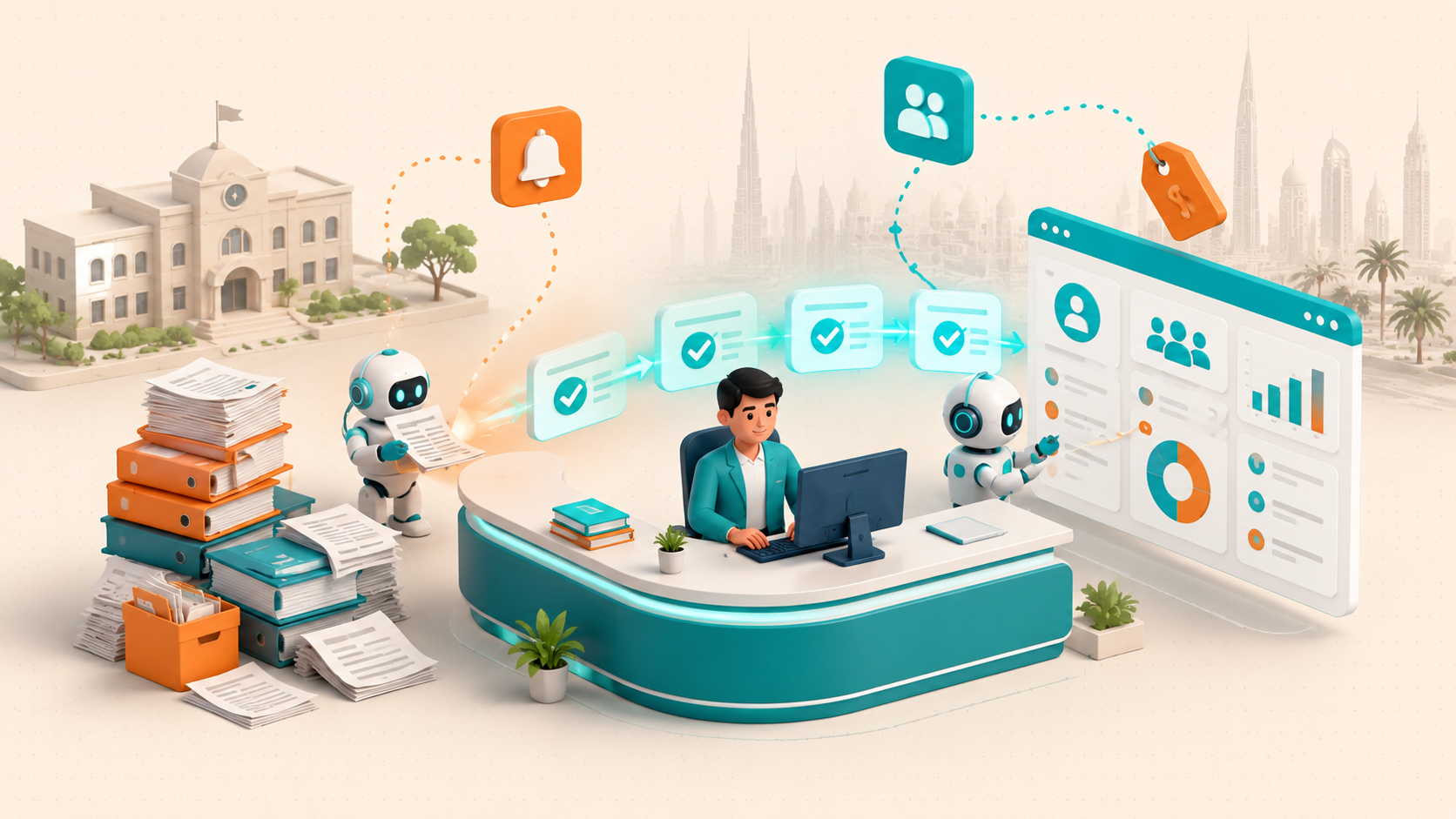
Ask most people what AI does in education and they will say "tutoring." That is one job out of many. In 2026, AI sits behind the scenes of a school day in ways students never see it drafts a teacher's quiz, flags the sophomore who quietly stopped submitting homework, captions a lecture in real time, routes a parent's email to the right office, and adjusts a reading passage to match a struggling learner's level. Tutoring is the part people notice. The rest is where a lot of the value actually lands.
This article is a wide-angle look at the roles AI plays across education and who benefits from each one. You will get the 2026 landscape with real market and adoption numbers, a breakdown of AI's main jobs personalized learning, tutoring, grading, operations, content, accessibility, and analytics the benefits sorted by student, teacher, administrator, and parent, a table mapping each role to who gains most, the risks worth taking seriously, and a practical way to start. If you run a school, build an edtech product, or lead a district's technology decisions, this gives you the full map instead of one corner of it.
Quick answer
AI now runs across the whole education system, not just tutoring. It powers personalized learning, automated grading, content creation, accessibility tools, and early-warning analytics that flag struggling students. The biggest payoffs are hours saved for teachers and support shaped around each learner — as long as schools stay on top of privacy, bias, and academic integrity along the way.
How schools and colleges actually use AI in 2026
AI moved from pilot projects to daily routine faster than most technologies before it. Teachers now use it to plan lessons and write feedback, students use it to study and check their work, and administrators use it to handle the paperwork that eats their week. The tools are familiar names ChatGPT, Google Gemini, Microsoft Copilot, Khanmigo, Grammarly — but the pattern underneath is what matters: AI has become a layer that touches nearly every task in a school, not a single app bolted onto the side.
The money follows the behavior. Grand View Research valued the AI-in-education market at roughly USD 8.3 billion in 2025 and projects it will reach about USD 32.27 billion by 2030. Precedence Research puts the 2025 figure near USD 7.05 billion and expects it to climb past USD 9.58 billion in 2026 on its way to USD 136.79 billion by 2035, a compound annual growth rate above 34%. The exact numbers differ by analyst, but every serious forecast points the same way — steep, sustained growth through the rest of the decade.
Adoption on the ground backs that up. A 2025 study from Gallup and the Walton Family Foundation found that about three in ten K-12 teachers use AI weekly, and the teachers who lean on it report saving close to six hours a week — the equivalent of roughly six weeks reclaimed over a school year. Time is the currency here. When AI absorbs the routine work, teachers get hours back for the part machines cannot do: sitting with a kid who is stuck.
Here is where AI shows up in a typical institution today:
- In the classroom: lesson planning, differentiated materials, real-time captioning, and on-demand explanations for students.
- In grading: instant scoring of quizzes and drafts, plus written feedback teachers can review and adjust.
- In the back office: scheduling, enrollment questions, email triage, and report generation.
- In student support: early-warning dashboards that spot attendance drops and grade slides before they become dropouts.
- In accessibility: text-to-speech, translation, and reading-level adjustment for learners with different needs.
Notice that only one of those bullets is student-facing tutoring. The bulk of AI's contribution in 2026 is quieter than that — it removes friction from the work adults do so schools can spend their limited human attention where it counts.
The main roles AI plays in education
It helps to think of AI in education as a set of distinct jobs rather than one big thing. Each role solves a different problem, benefits a different group, and carries its own risks. A school might adopt three of these and skip the rest, and that is a reasonable way to start. Here are the seven roles that matter most right now.
Personalized learning
This is the role with the deepest reach. AI adapts the pace, difficulty, and sequence of material to each learner, so a student who has mastered fractions moves ahead while a classmate who is stuck gets more practice and a gentler on-ramp.
Instead of one lesson aimed at the middle of the class, everyone works at the edge of their own ability. Adaptive platforms and learning experience platforms do this by watching what a student gets right and wrong, then reshaping the next step. Done well, personalization is what finally makes "meet every kid where they are" practical at the scale of thirty students per teacher.
AI tutoring
The visible role. An AI tutor answers questions, explains a concept a second and third way, and generates practice problems on demand available at 11 p.m. when no human teacher is. Tools built for this, like Khanmigo, are designed to coach rather than hand over answers. Tutoring deserves its own deep discussion, so we keep it brief here: treat it as one powerful role among several, valuable precisely because it extends help beyond the hours and headcount a school actually has.
Automated grading and feedback
Grading is where teachers lose entire evenings, and it is one of AI's clearest wins. AI can score quizzes instantly, evaluate short answers and essays against a rubric, and draft specific feedback a teacher then reviews and edits.
The point is not to remove the teacher from the loop it is to turn three hours of marking into thirty minutes of checking and adjusting. Students also get feedback faster, while the assignment is still fresh, which is when it actually helps them improve.
Administrative and operations automation
Schools run on paperwork scheduling, enrollment, attendance, forms, and a bottomless inbox. AI handles a growing share of it: chatbots answer routine parent and student questions around the clock, systems draft reports and letters, and routing tools send each request to the right office without a human sorting the pile. This is unglamorous work, and that is exactly why offloading it frees up so much staff time for the parts of the job that need a person.
Content generation
AI has become a fast first draft for teaching material. It produces lesson outlines, worksheets, quiz banks, reading passages at a target grade level, slide decks, and rubrics in minutes rather than hours. Teachers stay the editors they check accuracy, adjust tone, and keep the material aligned to the curriculum. The gain is speed on the blank-page problem, which is often the slowest part of preparing to teach.
Accessibility and inclusion
This role changes who can learn at all. AI powers real-time captioning for deaf and hard-of-hearing students, text-to-speech and speech-to-text for learners with dyslexia or motor differences, instant translation for multilingual classrooms, and reading-level adjustment so the same idea reaches students at different points. Support that once required a dedicated specialist and advance scheduling is now available on the spot, which pulls more students into the same lesson instead of leaving some behind.
Analytics and early-warning systems
AI is very good at spotting patterns in data no human has time to watch. Early-warning systems track attendance, grades, and engagement across a whole school and flag the students drifting toward failure or dropping out often weeks before a teacher would notice on their own. That head start is the whole value. It turns intervention from a reaction into a plan, letting a counselor reach a struggling student while there is still time to change the outcome.
What each group gets out of it: students, teachers, admins, parents
The same AI feature lands differently depending on who you are. A teacher values grading automation for the hours it returns; a student values it for feedback that arrives the same day. Sorting the benefits by stakeholder makes it easier to decide what to prioritize and how to explain the value to each group.
- Students get support that fits them help available outside class hours, material paced to their level, faster feedback, and accessibility tools that remove barriers. The result is less time stuck and more time actually progressing.
- Teachers get their time back. AI absorbs planning, grading, and paperwork, which frees hours for teaching, mentoring, and the relationship work that changes outcomes. It also gives them a clearer picture of who needs help.
- Administrators get efficiency and foresight automated operations that cut staff overhead, plus analytics that surface risks across the whole institution early enough to act on them.
- Parents get visibility and access clearer updates on how their child is doing, faster answers to routine questions through chat support, and translation that includes families who do not speak the school's primary language.
One benefit cuts across all four groups: consistency. A well-built AI system gives the same quality of feedback, the same patient explanation, and the same early flag whether it is a Tuesday morning or a Friday night, whether the class has fifteen students or forty. Humans get tired and stretched thin; that is not a criticism, it is a fact of the job.
AI holds the baseline steady so people can focus their energy where judgment and care are irreplaceable. If you want help mapping these gains to your own institution, our education technology work shows how these pieces fit together in real deployments.
| AI role | Who benefits most | Example in practice |
|---|---|---|
| Personalized learning | Students | Adaptive paths that adjust difficulty and pace to each learner |
| AI tutoring | Students | On-demand help and practice available outside class hours |
| Automated grading and feedback | Teachers | Instant scoring plus draft feedback the teacher reviews |
| Admin and operations automation | Administrators | Chatbots and routing that clear scheduling and inbox load |
| Content generation | Teachers | Fast drafts of worksheets, quizzes, and lesson outlines |
| Accessibility and inclusion | Students | Captioning, translation, and reading-level adjustment on demand |
| Analytics and early-warning | Administrators, parents | Dashboards that flag at-risk students weeks in advance |
Roles overlap in practice; "who benefits most" marks the primary gain, not the only one.
Where AI still needs a human in the loop
For all its reach, AI in education has hard limits, and pretending otherwise is how schools get burned. AI predicts likely answers from patterns in data. It does not understand a student, care whether they succeed, or know when its confident-sounding answer is simply wrong. Those gaps decide where a human has to stay in charge.
Grading is a good example. AI can score against a rubric and draft feedback fast, but it misreads unusual reasoning, creative answers, and context a rubric never anticipated. A teacher who rubber-stamps AI grades without reading them will penalize exactly the students who think differently. The same holds for content AI drafts a worksheet in seconds and will confidently include a fact that is subtly false. The teacher stays the editor for a reason.
The relationship layer resists automation entirely. Motivation, trust, encouragement, reading the room, noticing that a kid is quiet today because something is wrong at home none of that lives in a model.
Early-warning analytics can tell a counselor which student to check on, but the checking-in is human work, and it is the part that actually helps. The right mental model for 2026 is AI as a capable assistant that handles volume and speed, with educators owning judgment, care, and the final call. Schools that keep that division clear get the upside without handing over decisions machines should not make.
The risks, and how to use AI responsibly
Every role above comes with a downside, and the schools getting durable value are the ones that name the risks up front and build guardrails instead of hoping problems stay away. Four risks deserve real attention:
- Privacy and data security: Student data is sensitive and often legally protected. AI tools that collect grades, behavior, and personal details need clear policies on what is stored, who can see it, and whether the vendor trains its models on your students. Read the data terms before you sign, not after.
- Bias: AI learns from historical data, and historical data carries historical inequities. An early-warning system trained on biased records can flag some groups unfairly; a grading model can score dialects or non-standard phrasing lower. Audit outputs across student groups instead of assuming the tool is neutral.
- Academic integrity: The same tutor that helps a student can write their essay for them. Schools need honest policies about what AI use is allowed, assignment designs that reward thinking over output, and conversations with students rather than an arms race of detection tools that misfire.
- Over-reliance: If students outsource every hard step to AI, they stop building the reasoning the work was meant to develop. The same risk applies to teachers who stop checking AI's output. The tool should scaffold effort, not replace it.
Responsible use is not one policy you write once. It is an ongoing practice — a clear acceptable-use policy, training so staff know what the tools can and cannot do, human review on any decision that affects a student, and vendors vetted for how they handle data.
Districts and edtech teams that want a structured way through this often bring in outside help; our AI education consultation services exist to make those calls with you rather than leave you guessing.
How to start adding AI to your school or product
The mistake most institutions make is trying to adopt everything at once, which produces a scattered rollout no one trusts. A better path is narrow and evidence-driven: pick one painful problem, solve it well, prove the value, then expand. Here is a sequence that works whether you run a school or build an education product.
- Start with a real pain point. Grading load, repetitive parent questions, or students who fall behind unnoticed pick the one that costs your people the most time or stress.
- Pilot small. Run one tool with one willing group a few teachers, one grade, one department for a defined stretch. Keep it contained enough to learn fast.
- Set success metrics up front. Decide before you launch what "working" means: hours saved, faster feedback, fewer at-risk students slipping through. Measure against it.
- Train the people using it. Adoption fails on confusion, not technology. Show staff what the tool does, where it fails, and when to override it.
- Write the guardrails. Data handling, acceptable use, and human review should be in place before the pilot, not bolted on after something goes wrong.
- Expand on evidence. Roll out wider only where the pilot actually delivered. Let results, not hype, decide what scales.
For edtech companies, the same discipline applies to the build. Ship a focused capability, integrate it cleanly into a learning experience platform so it fits the way people already work, and validate demand before piling on features. Teams that need engineering muscle to design and ship these systems can lean on our AI services to move from idea to a product schools will actually use.
Where AI in education is heading after 2026
A few shifts are moving from experimental to expected, and they are worth watching as you plan. The clearest is agentic AI tools that do not just answer a question but carry out multi-step tasks, like assembling a full differentiated lesson set, running the practice, and reporting back on where each student struggled. That turns AI from a helper you prompt repeatedly into one you delegate a whole workflow to.
Personalization is also getting deeper. As models fold in more signals pace, error patterns, even how a student engages adaptive paths grow more precise, and the line between "the curriculum" and "this student's curriculum" keeps blurring. Alongside that, expect governance to catch up: clearer rules on student data, more scrutiny of bias, and procurement teams asking harder questions before they buy. That is healthy. The market is maturing past the phase where anything with "AI" in the name sells itself.
The through-line for the rest of the decade is not that AI replaces teachers. It is that AI keeps absorbing the routine, the repetitive, and the impossible-to-scale, while the human parts of education judgment, relationship, encouragement become more central, not less. The institutions that win will treat AI as leverage for their people rather than a substitute for them. Get the roles right, respect the limits, and manage the risks, and AI becomes one of the most useful things to happen to teaching in a generation.
Planning an AI move in education for 2026?
Third Rock Techkno helps schools and edtech companies choose the right AI roles, build the guardrails, and ship products learners actually use — from strategy to engineering. Tell us the problem you want to solve and we'll scope it with you.
Get a free consultation →Frequently asked questions
What are the main roles of AI in education?
AI plays seven core roles: personalized learning that adapts pace and difficulty, AI tutoring for on-demand help, automated grading and feedback, administrative and operations automation, content generation for teaching materials, accessibility tools like captioning and translation, and analytics that flag at-risk students early. Tutoring is the most visible, but grading, operations, and analytics often deliver the most time saved for staff.
Is AI in education just about tutoring?
No. Tutoring is one role among many, and often not the highest-value one. A lot of AI's impact in 2026 is behind the scenes — drafting lessons, grading, automating back-office paperwork, powering accessibility, and running early-warning systems that catch struggling students. Those quieter roles are where teachers and administrators get the biggest share of their time back.
How big is the AI in education market in 2026?
Grand View Research valued the AI-in-education market at roughly USD 8.3 billion in 2025 and projects about USD 32.27 billion by 2030. Precedence Research estimates it will pass USD 9.58 billion in 2026 on the way to USD 136.79 billion by 2035, a compound annual growth rate above 34%. Analysts differ on exact figures but agree on strong double-digit growth for the rest of the decade.
What are the biggest risks of using AI in schools?
Four stand out: privacy and data security around sensitive student information, bias in tools trained on unequal historical data, academic integrity when students use AI to do the work instead of learn, and over-reliance that erodes the reasoning skills assignments are meant to build. Each is manageable with clear policies, human review, staff training, and vendors vetted for how they handle data.
How should a school start adopting AI?
Start narrow. Pick one real pain point — grading load, repetitive parent questions, or students slipping through unnoticed — and pilot a single tool with a small, willing group. Set success metrics before you launch, train the people using it, put data and acceptable-use guardrails in place first, then expand only where the pilot actually delivered results.