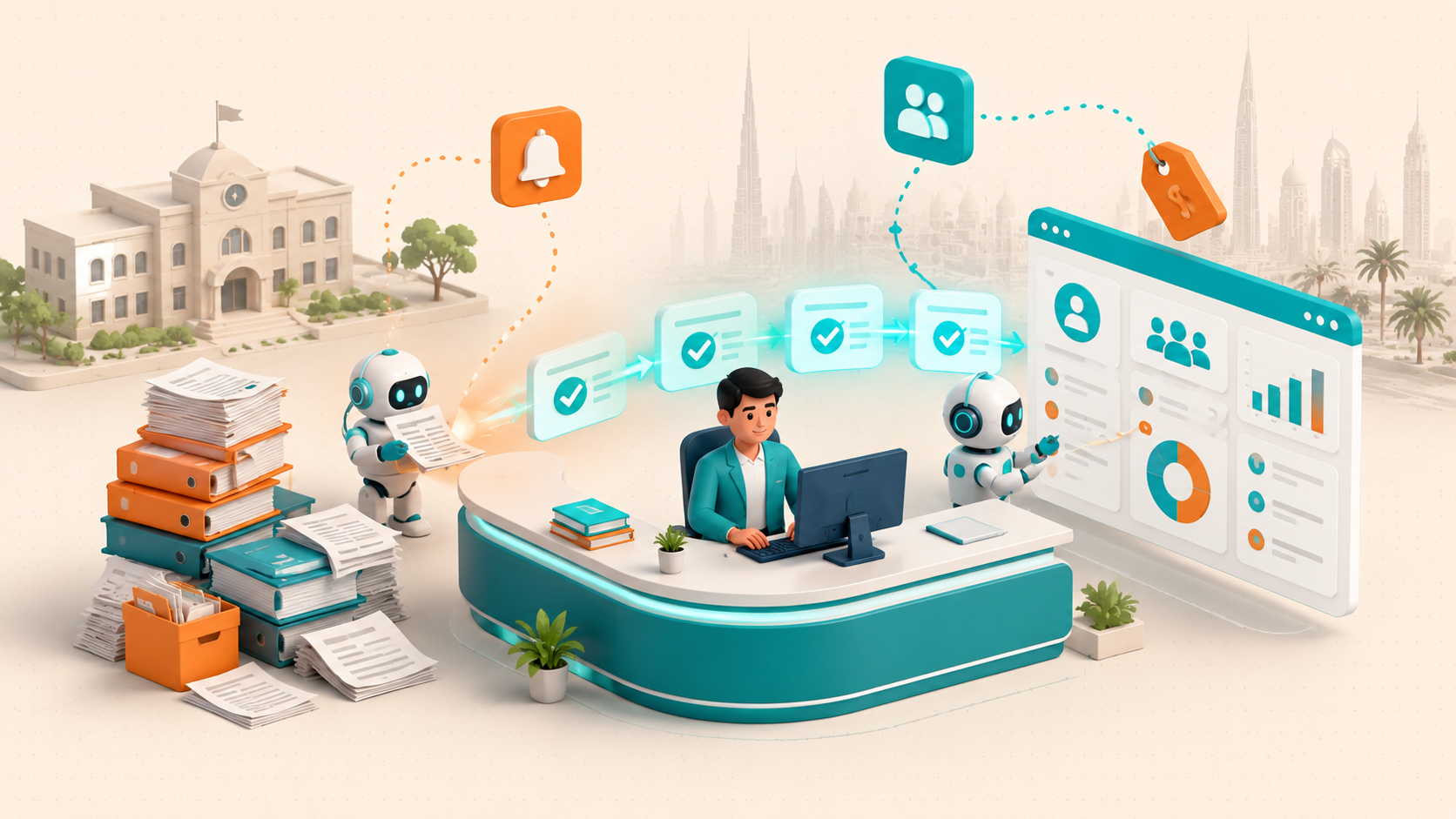
How AI Is Reshaping the Future of K-12 and Higher Education in the USA in 2026

- Student AI usage in the USA jumped from 66% to 92% in a single year — this is not gradual adoption, it's a wholesale classroom transformation.
- A Harvard 2025 study found AI tutors produce 2x learning gains vs. active learning classrooms — but only when designed with pedagogical guardrails.
- The AI in education market in the USA is projected to grow from $2.01 billion in 2025 to $32.64 billion by 2034.
- USA has zero binding federal AI curriculum standards as of May 2026 — policy is fragmented across states, creating uneven adoption.
- The #1 failure pattern: institutions adopt AI tools without intentional design, which can harm learning outcomes rather than improve them.
Here's a number that captures the scale of what's happening in classrooms: student AI usage jumped from 66% in 2024 to 92% in 2025. That's not gradual adoption. That's a wholesale transformation of how learning happens.
Meanwhile, 83% of K-12 teachers are using generative AI tools for lesson planning, feedback, or content support. A RAND study found that 54% of students and 53% of teachers used AI for school in 2025 — increases of more than 15 percentage points from just one to two years earlier.
The AI in education market in the USA alone is projected to reach $2.01 billion in 2025 and grow to $32.64 billion by 2034. North America dominates the global market with a 38% share, driven by Silicon Valley investment and strong digital infrastructure.
But raw adoption numbers only tell part of the story. A June 2025 Harvard study published in Scientific Reports found that students using a well-designed AI tutor learned more than twice as much in less time compared to those in traditional active-learning classrooms. They also reported feeling more engaged and motivated.
This isn't a question of whether AI will reshape American education. It already is. The real questions are how it's happening, what's working, what's failing, and what administrators, educators, and policymakers need to understand to navigate this shift.
| Metric | Value | Source |
|---|---|---|
| Student AI usage (2025) | 92% | University World News |
| K-12 teachers using generative AI | 83% | EdTech Digest 2025 |
| College students using AI (2026) | ~90% | Forbes 2026 |
| Weekly teacher time saved with AI | 5.9 hrs/week | MagicSchool AI Survey |
| AI tutoring learning gain (vs active learning) | 2x improvement | Harvard Study 2025 |
| USA AI-in-Education market size (2025) | $2.01 billion | Precedence Research |
| USA AI-in-Education market size (2034 projected) | $32.64 billion | Precedence Research |
| Urban teachers with no AI training | 68%+ | AIPRM 2025 |
| Students overly dependent on AI tools | 30%+ | Microsoft Research 2025 |
Quick answer
AI is reshaping US K-12 and higher education through personalized learning, AI tutoring, automated grading and smarter operations. In 2026 institutions use it to close achievement gaps and cut costs, while navigating data-privacy, equity and policy questions. This guide covers what's changing.
The Current State of AI in American Education
The data paints a picture of rapid, uneven adoption across every level of education.
In K-12 Schools:
According to a 2025 Carnegie Learning survey, K-12 educators in 49 states and Puerto Rico are using AI tools like ChatGPT and Gemini to create teaching materials, personalize learning, and boost student engagement.
The 2025-2026 Education Insights Report found that nearly all superintendents express excitement about AI's potential to support teaching and learning.
But excitement doesn't mean readiness. District leaders reported providing students with AI training as of spring 2025. More than 68% of urban teachers haven't received any AI training since joining their schools.
And while 71% of school districts planned to train teachers by Fall 2025, the gap between policy intention and classroom reality remains wide.
In Higher Education
By early 2026, an estimated 90% of college students use AI as their primary research and brainstorming partner. Students use an average of 2.1 AI tools for their courses, with ChatGPT leading at 66% usage, followed by Grammarly and Microsoft Copilot at 25% each.
The shift is dramatic: in 2024, 53% of university students in the UK used generative AI tools for assessments. By 2025, that figure jumped to 88%.
Want to see how this compares globally? Read our deep dive: Dubai vs Abu Dhabi: Which Emirate Moves Faster on AI in Education in 2026
The Policy Landscape:
April 2025 marked a significant federal milestone when President Trump signed the Executive Order "Advancing Artificial Intelligence Education for American Youth."
This order established a White House Task Force on AI Education and directed agencies to develop K-12 AI literacy resources, create public-private partnerships, and launch a Presidential AI Challenge.
The U.S. Department of Education followed with guidance on using federal grants for AI integration, including high-impact AI tutoring and administrative automation.
At the state level, all 50 states plus Washington DC and U.S. territories have considered AI-related legislation by mid-2025. Ohio and Tennessee enacted laws requiring school districts to develop their own AI policies. New York banned facial recognition technology in schools to protect student privacy.
More than half of state Departments of Education have issued guidance on AI in education, though few have enacted binding legislation.
The pattern is clear: guidance is proliferating, but hard regulation remains limited.
| State | Policy Status | Key Action |
|---|---|---|
| California | Guidance Issued | State DOE released voluntary AI use guidelines for K-12 schools |
| Texas | Guidance Issued | TEA published AI literacy framework for educators |
| Ohio | Law Enacted | Requires all school districts to develop AI use policies |
| Tennessee | Law Enacted | Mandated district-level AI policies with public transparency requirements |
| New York | Law Enacted | Banned facial recognition technology in all K-12 schools |
| Florida | Legislation Pending | Proposed AI curriculum standards for grades 6–12 under review |
| Illinois | Guidance Issued | ISBE published responsible AI use framework for teachers |
| All 50 States + DC | Legislation Considered | AI-related education legislation introduced or under consideration as of mid-2025 |
Sources: National Conference of State Legislatures, individual state DOE websites, 2025
Our team at Third Rock Techkno has delivered custom EdTech platforms and AI-powered learning tools for 50+ institutions. Talk to us →

How AI Is Actually Changing K-12 Classrooms
The transformation in K-12 education isn't theoretical. It's happening in specific, measurable ways.
Personalized Learning at Scale
Traditional classrooms deliver the same lesson to every student at the same pace. AI changes this equation fundamentally.
Adaptive learning platforms like DreamBox and Carnegie Learning use machine learning to analyze student responses in real time, adjusting difficulty, pacing, and content based on individual performance.
When a student struggles with fractions, the system provides additional scaffolding. When they master a concept quickly, it advances them to new material.
The results are measurable: students complete courses better with AI-personalized learning compared to traditional methods. Platforms using this approach have seen reductions in achievement gaps within a single semester.
Teacher Time Savings
Teachers who use AI tools at least weekly save an average of 5.9 hours per week, roughly equivalent to six extra weeks of reclaimed time across a school year. That's time that would otherwise go to lesson planning, grading, and administrative tasks.
MagicSchool AI, one of the leading teacher-focused platforms, helps educators create lesson plans, generate differentiated materials, and draft feedback on student work. The time savings allow teachers to focus on what matters most: direct instruction and relationship-building with students.
74% of teachers report that AI improves the quality of their administrative work. Teachers who use AI more frequently are more likely to report quality improvements, according to Gallup research.
Intelligent Tutoring Systems
The Harvard study published in June 2025 represents a breakthrough in understanding AI tutoring effectiveness. Researchers developed "PS2 Pal," a custom AI tutor built on GPT-4 and designed using evidence-based pedagogical principles.
Key design elements included: brief responses (no more than a few sentences) to avoid cognitive overload, revealing only one step at a time rather than full solutions, and encouraging students to attempt problems themselves before receiving help.
The results: students using the AI tutor achieved more than twice the learning gains compared to those in active learning classrooms. They also reported significantly higher engagement and motivation.
This matters because active learning — where students engage with material through discussion and problem-solving rather than passive listening — is itself a significant improvement over traditional lectures. AI tutoring outperformed even this enhanced approach.
| Tool | Primary Use | Best For | Pricing |
|---|---|---|---|
| ChatGPT (OpenAI) | Writing, research, Q&A | Students (grades 6–12) | Free / $20/mo |
| MagicSchool AI | Lesson planning, feedback | Teachers (all grades) | Free / $9.99/mo |
| Carnegie Learning | Adaptive math & literacy | K-12 districts | District license |
| DreamBox Learning | Adaptive math (K-8) | Elementary/Middle school | School/District license |
| Khanmigo (Khan Academy) | AI tutoring, Socratic Q&A | Students K-12 | $44/yr (students) |
| Canva for Education | Visual content creation | All grades, teachers | Free for schools |
| Gemini for Education | Research, writing assistance | Students & teachers | Free (Google Workspace) |
Assessment and Feedback
AI tools can auto-grade objective assessments instantly, freeing teachers from the 9.9 hours per week that Learnosity research found they spend on grading alone. Beyond simple multiple choice, AI now assists with rubric-aligned feedback on essays, identifying patterns in student misconceptions, and flagging at-risk students.
The 2025-2026 Education Insights Report notes that 59% of students agree the way they're assessed is changing due to generative AI. Assessment design is evolving to emphasize process over product — students demonstrating their thinking, not just their answers.
For a deeper look at how AI is automating assessment workflows, see our guide: AI in Education: Top Use Cases and Real-Life Examples in 2026
How AI Is Transforming Higher Education
Higher education faces a different set of challenges and opportunities than K-12. The stakes are higher, student autonomy is greater, and institutional complexity creates both barriers and opportunities for AI integration.
Enrollment and Retention
Georgia State University pioneered AI chatbot use in higher education admissions with "Pounce," launched in 2016. The chatbot addresses summer melt — the phenomenon where students accept admission but never enroll.
Results have been significant: Georgia State reduced summer melt from 19% to 9% through AI-powered text messaging. The chatbot achieved a 3.3% increase in enrollment and a 21.4% reduction in summer melt among students who committed by the priority deadline.
During the first summer, Pounce interacted with incoming students 185,000 times — a volume impossible for even the largest admissions office to handle manually.
Georgia State has since received a $7.6 million Department of Education grant to study AI-enhanced chatbots in critical undergraduate math and English courses, testing whether admissions success can translate to academic outcomes.
See how institutions are deploying AI chatbots for student engagement: AI Chatbots for E-Learning & Why They Matter in 2026
Rethinking Assessment and Academic Integrity
The academic integrity conversation has evolved rapidly. In 2023, the focus was on detecting students who used AI to cheat.
By 2025, institutions began recognizing that detection is a losing game and that the question should be how students use AI, not whether they do.
Forward-thinking institutions are redesigning assessments entirely: oral defenses, AI co-authored writing with transparent attribution, simulation-based evaluations, and collaborative projects that require demonstrating process, not just product.
By the end of 2026, AI literacy — the ability to understand, critique, and responsibly apply AI — is expected to be embedded across degree programs at leading institutions.
The concept of "authentic student work" is being redefined around transparency and demonstrated thinking rather than AI-free production.
New Academic Structures
The transformation runs deeper than tools and policies. Universities are restructuring themselves around AI.
In December 2025, the University of Wisconsin-Madison Board of Regents approved the creation of a standalone College of Computing and Artificial Intelligence, set to begin operations on July 1, 2026.
This is UW-Madison's first new academic college since 1983 — a signal that AI has crossed a threshold where existing structures are no longer adequate.
AI programs are spreading beyond traditional computer science departments into engineering, business, mathematics, and statistics programs.
Master's programs in AI have grown to 310 programs nationally, with bachelor's programs at 193. Roughly 53% are independent AI degrees; 47% are concentrations within larger programs.
Our team has built scalable LMS and eLearning platforms for institutions across the USA and GCC. Read our complete guide to LXP vs LMS: Which Platform Fits Your School, or talk to us directly →
The Risks and Concerns
Not everyone sees AI's educational expansion as positive, and the concerns are substantive.
Critical Thinking and Learning Quality
Only 22% of district leaders shared this concern — a significant perception gap between those closest to students and those making technology decisions.
A University of Pennsylvania study found that unrestricted access to generative AI without guardrails significantly harmed learning outcomes in high school mathematics. Students with unguided AI access performed worse on subsequent assessments than those who worked through problems unaided.
The mechanism is straightforward: when AI provides solutions on demand, students bypass the cognitive processes that build understanding. They mistake fluent AI-generated explanations for their own comprehension.
The Harvard study's success came specifically from careful design that prevented the AI tutor from giving full solutions, to encourage student attempts first, and to scaffold rather than replace thinking.
Over-Reliance and Dependency
Over 30% of students can become overly dependent on AI tools, according to Microsoft research. Half of students say they're worried they'll be falsely accused of using AI to cheat — a concern that reflects both actual AI use and anxiety about the surveillance environment it creates.
88% of students acknowledged using generative AI for tests in 2025, compared to 53% in 2024. Nearly 1 in 5 students leave unedited AI content in their work. The line between assistance and replacement is blurry, and students are often navigating it without clear guidance.
Teacher Perspectives
Teacher views on AI are more complex than administrator enthusiasm suggests. A substantial number feel unsure how AI will affect learning, and perceptions differ significantly by grade level.
Negative views appear more in older grades: 35% of high school teachers report concerns compared to 19% of elementary teachers. This may reflect the higher stakes of academic integrity at upper levels or greater direct exposure to AI misuse.
43% of teachers buy AI tools with their own money, and 89% prefer tools that cost less than $10 per month. The gap between institutional investment and individual teacher adoption creates inequity in who has access to effective AI tools.
Equity and Access
AI has the potential to democratize education — making high-quality tutoring that previously required expensive human tutors available to all. But it also risks widening gaps.
Schools with robust digital infrastructure can implement AI tools that under-resourced schools cannot. Students with home internet and devices have AI access that peers without them lack. Teachers with training can use AI effectively; those without training may misapply it or avoid it entirely.
The April 2025 Executive Order emphasized public-private partnerships and expanding AI access, but the implementation details on how resources actually reach under-resourced schools remain works in progress.
What's Working: Success Patterns
Across the research and case studies, several patterns distinguish effective AI integration from problematic implementation.
Intentional Design Over Default Tools
The Harvard study succeeded not because of the underlying technology — GPT-4 powers both the effective PS2 Pal tutor and the unguided ChatGPT access that harmed learning in other studies. The difference was entirely in design.
Effective AI educational tools are built around pedagogical principles: appropriate scaffolding, encouraging student thinking before revealing answers, brief responses that avoid cognitive overload, and feedback aligned to learning objectives rather than just task completion.
Default tools like ChatGPT are designed for user-friendly task completion, not for the friction-filled process of learning. Without intentional constraints, they undermine rather than support educational goals.
Clear Expectations and Policies
Schools where AI is successful have clear policies that students and teachers understand. This includes when AI use is appropriate, what attribution looks like, and how assessment accounts for AI assistance.
The institutions ahead are those that frame AI as a tool supporting their educational mission — access, equity, and learning — rather than an efficiency hack or a problem to police.
Professional Development
School districts planned to train teachers by Fall 2025, but the quality and depth of that training matter enormously. 59% of educators would like "train the trainer" programs to help them teach AI effectively.
Teachers need more than technical how-to; they need pedagogical frameworks for integrating AI into instruction, assessment literacy for the AI era, and time to experiment and adopt.
Student AI Literacy
Effective programs teach students not just to use AI but to understand it: how it works, where it fails, what biases it may contain, and how to evaluate AI-generated content critically. This moves beyond tool training to genuine digital literacy.
For schools evaluating full-scale automation of admin and learning workflows, our guide on Education Workflow Automation: What It Is and Why It Matters in 2026 is worth reading alongside this.
Looking Ahead: 2026 and Beyond
The trajectory points towards deeper integrations, not retreat.
From Experimentation to Infrastructure
2026 is expected to mark a transition from experimental adoption to system-wide integration. AI will stop being the thing education talks about and become the thing it plans alongside — embedded in institutional strategy rather than treated as a separate initiative.
The institutions that will thrive are those adopting AI with a purpose aligned to their specific mission and problems, not simply adopting AI for its own sake.
AI Literacy as Core Competency
By the end of 2026, AI literacy is expected to be as essential as digital literacy, embedded across disciplines rather than siloed in technology courses. This includes the ability to understand, critique, and responsibly apply AI — not just the ability to prompt effectively.
Assessment will continue evolving to value transparency in learning journeys, giving students freedom to approach problems creatively while demonstrating their thinking process.
Policy Maturation
State and federal policy is moving from guidance to structure. More binding legislation is expected in 2026, likely focusing on teacher training requirements, data privacy protections, and potentially AI literacy standards.
The December 2025 Executive Order on national AI policy framework signaled federal intent to establish consistent standards rather than leaving 50 states to create discordant approaches.
The Bubble Question
Some experts warn that the AI bubble may burst, reducing external pressure on institutions to deploy AI. Others predict continued acceleration regardless of market dynamics, given the fundamental efficiency gains and learning improvements that well-designed AI can deliver.
The prudent approach: build AI strategies that make sense for educational outcomes regardless of market hype cycles.
What This Means for Administrators and Educators
For those responsible for AI decisions in educational institutions, several principles emerge from the evidence:
Start with learning objectives, not technology. The question isn't "How can we use AI?" It's "What educational outcomes do we want, and can AI help achieve them?"
Invest in design, not just tools. Off-the-shelf AI tools without pedagogical guardrails may harm learning. The institutions seeing results are those building or selecting tools designed for educational purposes, with appropriate constraints.
Prioritize teacher development. Teachers are the key interface between AI tools and students. Training that addresses pedagogy, not just technology, creates sustainable implementation.
Address equity proactively. AI can widen gaps as easily as it can close them. Explicit strategies for equitable access to devices, connectivity, training, and effective tools are essential.
Engage stakeholders. The Department of Education guidance emphasized engaging affected stakeholders — especially parents — in decisions about AI adoption. Transparency about how AI is used and why builds trust and surfaces concerns early.
Measure what matters. Engagement and retention, not just technology deployment, should be the leading indicators of AI's success. If AI isn't improving student outcomes, it's not working.
Conclusion
The evidence shows that well-designed AI tools can double learning outcomes and dramatically improve student engagement. It also shows that poorly implemented AI can harm learning, enable academic dishonesty, and widen existing inequities.
The difference lies in intentionality. Institutions that approach AI as a tool for achieving their educational mission — with clear policies, trained educators, and thoughtful design — are seeing genuine results. Those who adopt AI reactively or without pedagogical grounding risk making things worse.
The transformation is happening whether institutions choose to lead it or not. The students are already using AI. The question is whether educators and administrators will shape that use toward learning, or leave it to chance.
We've been building EdTech platforms since 2015. From intelligent tutoring systems to enrollment chatbots, we turn AI ideas into tools that actually help students learn. Book a call with our team.
Bringing AI into your school or EdTech product? Third Rock Techkno offers AI in education consulting and builds custom education software and learning platforms — from strategy through deployment. Book a free consultation.