AI Agents in Education: How Autonomous AI Is Transforming Learning in 2026



86% of students now use AI for their studies, yet only 10% of schools have established guidelines for it. This gap represents both a challenge and a massive opportunity. AI agents aren't chatbots that answer questions.
They're autonomous systems that can tutor students 24/7, predict which learners will drop out before it happens, and automate administrative queries without human intervention.
The global AI education market is projected to reach $112.3 billion by 2034, growing at 38.4% annually. Schools that implement AI agents effectively are seeing 12% higher graduation rates, 35% improved student engagement, and teachers saving 5-10 hours per week on routine tasks.
This guide breaks down exactly what AI agents do, which ones are working in real schools today, and how to implement them, whether you're a school administrator, EdTech leader, or education technology partner.
Quick answer
AI agents in education autonomously handle tasks like tutoring, admissions queries, grading support and admin workflows — acting, not just answering. In 2026 schools and EdTech companies use them to personalize learning and cut staff workload, with humans overseeing decisions that affect students.
TL;DR: Key Takeaways
- What are AI agents? Autonomous software that monitors student behavior, predicts outcomes, and takes action without constant human input, unlike chatbots that only respond when asked
- Market size: $112.3 billion by 2034, growing at 38.4% annually
- Proven results: 12% higher graduation rates, 35% improved engagement, 5-10 hours saved per teacher weekly
- Top use cases: Personalized learning paths, 24/7 tutoring, dropout prediction, automated grading, administrative automation
- Leading platforms: Khanmigo, Carnegie Learning MATHia, Squirrel AI, Gradescope, Georgia State GPS
- Implementation timeline: Basic tools in days, full-scale deployment in 3-6 months
- Cost range: $44/student/year (Khanmigo) to $500,000+ (enterprise custom solutions)
What Are AI Agents in Education?
An AI agent is an autonomous software system that can perceive its environment, make decisions, and take actions to achieve specific goals without constant human input. Unlike traditional AI tools that respond only when prompted, agents proactively monitor, adapt, and intervene.
AI Agents vs. Chatbots vs. Traditional AI
The key differentiator: AI agents don't wait for instructions. They continuously analyze student behavior, identify patterns, predict outcomes, and take action. When a student shows early signs of disengagement, the agent intervenes before a teacher even notices the problem.
Thinking About AI Agents for Your School?
We help schools figure out which AI tools actually work for their students.

Top 7 Use Cases of AI Agents in Education
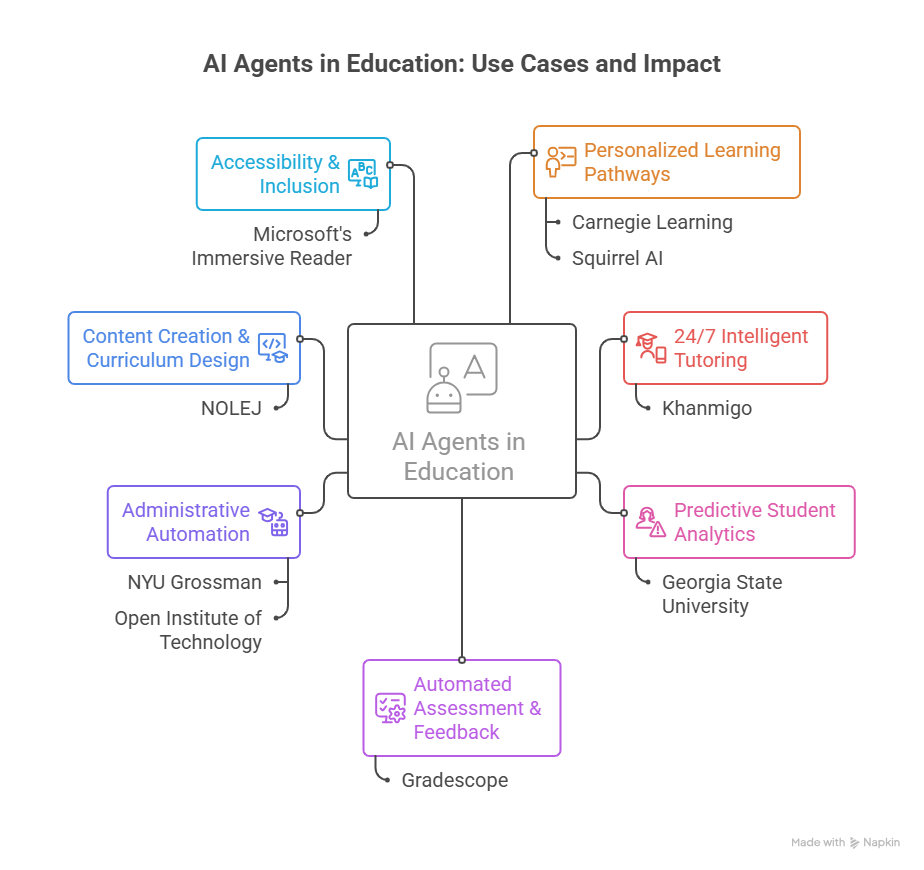
These aren't theoretical applications. Schools and universities are using AI agents today to solve real problems. Here's what's working:
1. Personalized Learning Pathways
AI agents analyze how each student learns—their pace, preferred formats, knowledge gaps—and continuously adjust the curriculum to create personalized learning paths for every student. Carnegie Learning's MATHia serves 600,000+ students, identifying specific misconceptions and generating targeted exercises.
Result: 68% of students show significant learning gains versus traditional instruction. Squirrel AI in China breaks curricula into thousands of "knowledge points" and adapts lessons in real-time. This approach to adaptive learning in education has proven effective across multiple implementations. Students using the platform improved scores within two months.
2. 24/7 Intelligent Tutoring
Khanmigo (Khan Academy's GPT-4 powered tutor) doesn't just give answers, it asks guiding questions, adapts explanations to each student's level, and encourages critical thinking.
In pilot programs, students reported feeling more confident in problem-solving. Teachers observed increased engagement, especially among quieter students who were hesitant to ask questions in class.
Unlike human tutors, these agents are available at 2 AM when a student is stuck on homework, and they never get frustrated repeating explanations.
3. Predictive Student Analytics
AI agents monitor attendance, assignment submissions, forum participation, and learning patterns to identify at-risk students weeks before problems become visible.
Georgia State University's GPS system generated over 250,000 advisor interventions, helping eliminate achievement gaps across demographic groups. The system identifies students who might struggle by week 3 of a course, with 74% accuracy that improves to 89% by week 15.
4. Automated Assessment & Feedback
Gradescope reduces grading time by while providing more detailed feedback than most teachers have time to write. But modern AI agents go further, they can evaluate essays for structure, argument quality, and critical thinking.
Teachers report that automated grading reduces their stress and gives them more time for high-value activities like one-on-one student interaction.
5. Administrative Automation
AI agents handle 80% of routine administrative queries, course registration, deadline reminders, and scheduling conflicts without human intervention.40% of universities now use AI for scheduling and enrollment.
NYU Grossman saved 6,000+ hours annually on application screening alone. The Open Institute of Technology (OPIT) in Europe deployed an AI agent that cut time spent on grading and correction by 30%.
6. Content Creation & Curriculum Design
AI agents generate lesson plans, quiz questions, study guides, and interactive exercises aligned with learning objectives.
NOLEJ's platform creates complete interactive learning modules within minutes. 44% of teachers now use AI for research and content gathering, 38% for lesson planning, and 37% for generating classroom materials. See our complete guide to AI tools for teachers for specific recommendations.
7. Accessibility & Inclusion
AI agents make education accessible to students with learning disabilities. Microsoft's Immersive Reader, used in thousands of classrooms globally, helps students with dyslexia process written text.
AI translation agents subtitle lectures for non-native speakers, detect dialects, and adapt content to regional language patterns. For students with ADHD who struggle with concentration, AI tutors adjust lesson pacing and presentation format to maintain engagement.
Not Sure Where to Start with AI in Education?
Stop drowning in vendor pitches. We'll walk you through what's real, what's hype, and what fits your budget.
Best AI Agents for Education: Platform Comparison (2026)
| Platform | Type | Best For | Key Features | Pricing | Rating |
|---|---|---|---|---|---|
| Khanmigo | AI Tutor | K-12, All Subjects | GPT-4 powered, Socratic method, writing feedback | $44/student/year | ⭐⭐⭐⭐⭐ |
| Carnegie Learning MATHia | Adaptive Learning | 6-12 Math | Cognitive tutor, 600K+ students, misconception detection | Institution pricing | ⭐⭐⭐⭐⭐ |
| Squirrel AI | Personalized Learning | K-12, China/Asia | 10,000+ knowledge points, real-time adaptation | Institution pricing | ⭐⭐⭐⭐ |
| Gradescope | Assessment | Higher Ed | AI grading, handwriting recognition, feedback automation | $3-5/student/course | ⭐⭐⭐⭐⭐ |
| Century Tech | Learning Platform | K-12, UK/International | AI pathways, teacher dashboard, standards-aligned | £5-10/student | ⭐⭐⭐⭐ |
| Querium | STEM Tutoring | Higher Ed | Step-by-step AI tutoring, workforce training | Custom pricing | ⭐⭐⭐⭐ |
| Cognii | Writing Assessment | Higher Ed | NLP-based essay feedback, critical thinking assessment | Institution pricing | ⭐⭐⭐⭐ |
| NOLEJ | Content Creation | Educators | Auto-generates interactive modules, quiz creation | Freemium | ⭐⭐⭐⭐ |
How to Choose the Right AI Agent Platform
| If You Need... | Consider... | Why |
|---|---|---|
| Free/low-cost tutoring | Khanmigo | $44/year, comprehensive subjects |
| Math intervention | Carnegie Learning MATHia | Proven 68% learning gains |
| Grading automation | Gradescope | Reduces grading time by 70%+ |
| Dropout prediction | Custom solution | Requires integration with your SIS |
| Content creation | NOLEJ | Generates materials in minutes |
| Full personalization | Squirrel AI or custom build | Deep adaptive learning |
Real-World Examples of AI Agents in Education
Example 1: Georgia State University (Predictive Analytics)
- The Problem:
High dropout rates, especially among first-generation and low-income students.
- The AI Agent Solution:
Georgia State's GPS Advising system uses AI agents to monitor 800+ risk factors for each student, from class attendance to cafeteria purchases. When patterns suggest a student might be struggling, the system automatically alerts advisors.
- Results
- 250,000+ advisor interventions generated.
- Graduation rates increased by 7 percentage points.
- Achievement gaps eliminated across demographic groups.
- 74% accuracy in predicting at-risk students by week 3.
Example 2: Carnegie Learning MATHia (Personalized Tutoring)
- The Problem
Teachers cannot provide individualized math instruction to 30+ students simultaneously.
- The AI Agent Solution
MATHia's cognitive tutor analyzes each step a student takes when solving problems, identifying specific misconceptions and adjusting instruction accordingly.
- Result
- 600,000+ students served.
- 68% of students show significant learning gains.
- Identifies misconceptions human teachers often miss.
- Provides instant feedback on every problem step.
Example 3: OPIT Europe (Administrative Automation)
- The Problem
Faculty spending excessive time on grading and administrative tasks.
- The AI Agent Solution
The Open Institute of Technology deployed AI agents to handle routine grading, student queries, and scheduling.
- Result
- 30% reduction in time spent on grading and correction.
- Faculty redirected time to student mentorship.
- Student satisfaction increased.
Example 4: Duolingo (Adaptive Language Learning)
- The Problem
Language learning requires constant practice and immediate feedback.
- The AI Agent Solution
Duolingo's AI agents adapt lesson difficulty based on performance, use spaced repetition for optimal retention, and provide instant pronunciation feedback.
- Result
- 500+ million users worldwide.
- Equivalent to university-level language courses.
- Personalized learning paths for each user.
5 Proven Benefits of AI Agents in Education
1. Hyper-Personalization at Scale
One teacher with 30 students can't deliver individualized instruction. AI agents can. Students using AI-driven platforms score higher on average than their peers in traditional classrooms.
2. Early Intervention
AI agents can lower dropout rates by 20% by identifying struggling students before they fail. Predictive analytics catch problems that human observation misses.
3. Cost Efficiency
Schools report cost savings with AI-powered administrative systems. Johns Hopkins University reduced research costs by having AI agents handle literature reviews and documentation.
4. 24/7 Support
AI tutors don't sleep. Students can get help at midnight, on weekends, or during holidays, exactly when they often need it most.
What Are AI Voice Agents?
AI voice agents use speech recognition and natural language processing to interact with students through spoken conversation. Unlike text-based chatbots, voice agents allow hands-free interaction and can: -
- Read content aloud for students with visual impairments or dyslexia.
- Practice pronunciation and conversation for language learners.
- Answer questions verbally during lab work or hands-on activities.
- Support young children who cannot yet type.
AI Voice Agent Use Cases in Education
| Use Case | How It Works | Example |
|---|---|---|
| Language Learning | Students practice speaking with AI that provides pronunciation feedback | Duolingo's voice exercises |
| Accessibility | Voice agents read content and accept verbal responses | Amazon Alexa skills for education |
| Virtual Office Hours | Students ask questions verbally and receive spoken explanations | Custom voice-enabled tutors |
| Assessment | Oral exams conducted and evaluated by AI | Language proficiency testing |
| Campus Navigation | Voice assistants help students find resources | University help desks |
Challenges with Voice Agents in Education
- Accuracy: Speech recognition struggles with accents, background noise, and young children's speech patterns.
- Privacy:Recording student voices raises additional data concerns.
- Infrastructure: Requires microphones and quiet spaces.
- Cost: More expensive to implement than text-based agents.
How to Implement AI Agents in Your School
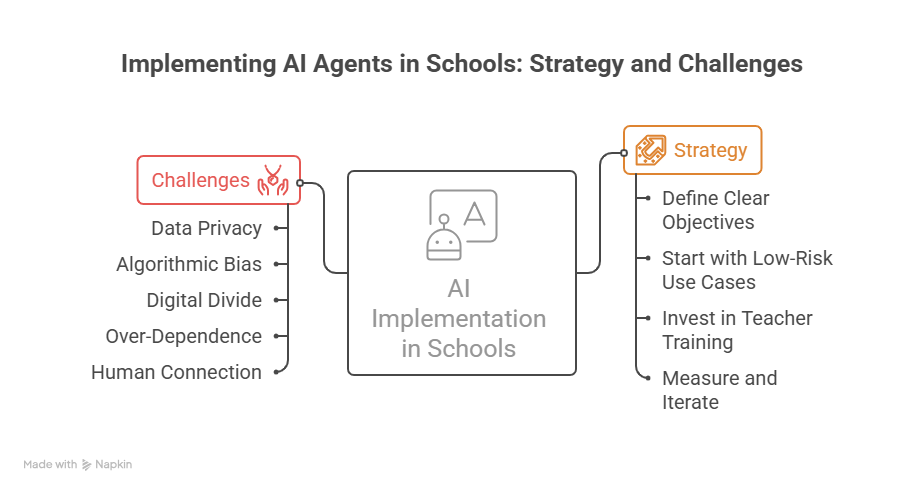
Successful AI implementation requires strategy, not just technology. Here's a proven roadmap.
1. Define Clear Objectives
Start with specific problems: reducing dropout rates, improving math scores, automating grading, or streamlining enrollment. Vague goals like "use more AI" lead to failed pilots.
2. Start with Low-Risk Use Cases
Begin with grading assistance, accessibility support, or enrollment triage, not high-stakes assessment or student discipline. Build trust before expanding.
3. Invest in Teacher Training
Urban teachers have received no AI training. Teachers who understand AI's capabilities and limitations use it more effectively. Training should cover both technical "how-to" and pedagogical integration strategies.
4. Measure and Iterate
Track outcomes: test scores, engagement rates, time saved, student satisfaction. If something isn't working, adjust. The best implementations evolve continuously.
Challenges & Ethical Considerations
AI agents aren't a magic fix. Schools must navigate real concerns:
1. Data Privacy
Americans are more concerned than excited about AI in daily life. Student data requires strict protection, and schools have established AI usage guidelines (UNESCO).
2. Algorithmic Bias
AI trained on biased datasets can perpetuate inequities. Systems might unfairly flag students from certain demographics as "at-risk" based on historical patterns rather than individual behavior.
3. Digital Divide
Rural and underfunded schools may lack infrastructure for AI implementation. Without inclusive policies, AI benefits flow to already privileged institutions.
4. Over-Dependence
Students may become overly dependent on AI tools. Schools must teach responsible use alongside AI integration.
5. Human Connection
AI should augment teachers, not replace them. Social-emotional learning, mentorship, and peer collaboration require human relationships that technology can't replicate.
The Future: What's Coming in 2025-2026
1. Human-AI Collaborative Teaching
Expect AI agents to function as "co-teachers" handling real-time task adaptation while human educators focus on mentorship and complex discussions. Early experiments show teachers can spend less time on rote work and more on high-value interactions.
2. Emotional Intelligence in AI
Next-generation agents will detect student frustration, anxiety, or disengagement through behavioral patterns and adjust their approach. This affective computing capability will make AI tutoring feel more human and responsive.
3. Lifelong Learning Companions
AI agents will evolve into persistent learning partners that follow individuals from school through career transitions, remembering learning preferences, identifying skill gaps, and recommending development opportunities for decades.
Ready to Build Your Own AI Learning Platform?
Let's turn your vision into a system that actually helps students learn.
Conclusion
The question isn't whether AI will transform education, it's whether your institution will lead or follow. Schools that implement AI agents effectively are already seeing higher graduation rates, better student engagement, and more efficient operations.
Third Rock Techkno builds custom AI solutions for education. From intelligent tutoring systems to predictive analytics platforms, we help schools and EdTech companies implement AI that actually works. With 80+ developers specializing in AI development for EdTech and 9+ years serving EdTech clients globally, we understand both the technology and the pedagogy.
Let's Build Your AI Education Solution
Book a free consultation to discuss your requirements.
Bringing AI into your school or EdTech product? Third Rock Techkno offers AI in education consulting and builds custom education software and learning platforms — from strategy through deployment. Book a free consultation.
FAQs
What is an AI agent in education?
An AI agent in education is autonomous software that monitors student behavior, makes decisions, and takes actions to improve learning outcomes without constant human input. Unlike chatbots that only respond when asked, AI agents proactively predict which students might struggle, automatically adjust lesson difficulty, and alert teachers when intervention is needed. Examples include Khanmigo for tutoring and Georgia State's GPS system for dropout prediction.
What is the difference between AI agents and chatbots in education?
CChatbots respond to questions when asked. AI agents act autonomously and proactively. A chatbot answers "What's the homework?" when a student asks. An AI agent notices a student hasn't submitted homework in three days, checks their login patterns, identifies they might be disengaging, and alerts the teacher before anyone asks. AI agents are goal-driven systems that continuously monitor, predict, and intervene.
What are examples of AI agents in education?
Examples of AI agents in education include: Khanmigo (Khan Academy's GPT-4 tutor), Carnegie Learning MATHia (adaptive math instruction), Squirrel AI (personalized learning in China), Georgia State GPS (dropout prediction), Gradescope (automated grading), Century Tech (UK adaptive learning), and NOLEJ (content generation). Each serves different needs from tutoring to administration.
How much do AI agents for schools cost?
AI agent costs vary widely. Khanmigo costs around $44 per student per year. Gradescope runs $3-5 per student per course. Enterprise solutions like custom dropout prediction systems range from $10,000 to $500,000+ depending on scale and customization. Many schools start with free tools before investing in specialized platforms. ROI typically comes from reduced dropout rates, time savings, and improved outcomes.
Can AI agents replace teachers?
No. AI agents augment teachers by handling routine tasks so educators can focus on mentorship, critical thinking, and social-emotional support that only humans can provide. Schools using AI effectively report teachers spend more time on high-value activities, not less. The goal is human-AI collaboration: AI handles grading, monitoring, and routine questions while teachers handle relationships, complex discussions, and emotional support.
What are AI voice agents in education?
AI voice agents use speech recognition to interact with students through spoken conversation. They're used for language learning pronunciation practice, accessibility support for visually impaired students, and hands-free assistance during lab work. Examples include Duolingo's speaking exercises and educational Alexa skills. Voice agents are emerging but face challenges with accent recognition and privacy concerns.
How do AI agents personalize learning?
AI agents personalize learning by continuously analyzing student performance data: time spent on tasks, error patterns, learning pace, and engagement levels. Based on this analysis, agents adjust content difficulty, recommend specific resources, identify knowledge gaps, and predict when students need support. Carnegie Learning's MATHia, for example, breaks math into thousands of "knowledge points" and adapts lessons in real-time based on each student's mastery.
How long does it take to implement AI agents in schools?
Implementation timelines vary by scope. Basic tools like grading assistants can be deployed in days. Pilot programs typically run 1-2 months. Full-scale implementations with custom integrations require 3-6 months. Most successful implementations start small (one grade level or subject), prove value, then expand. The timeline depends on existing infrastructure, staff training needs, and integration complexity.